Rendering Reality: From Solid Matter to the Cosmic Database

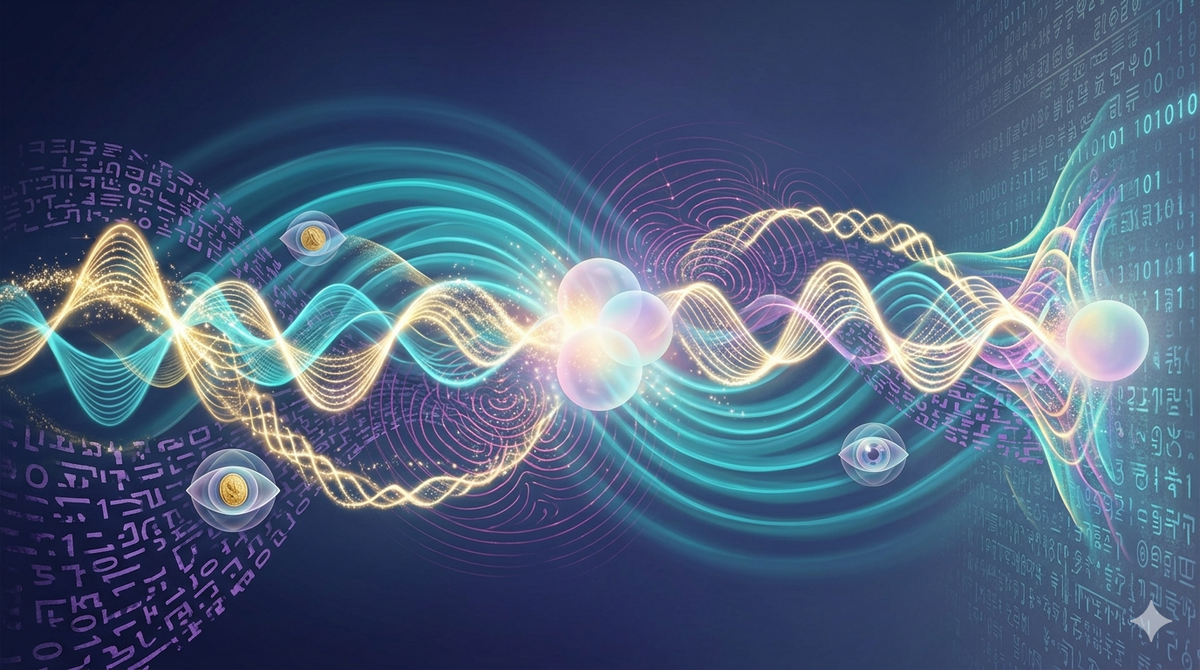
An exploration of the fabric of our existence, from solid matter to the information beneath. In this deep dive, we decode the rendering of reality and why viewing the universe as a cosmic database is the ultimate upgrade for your perception.
Whether you prefer to read or listen, the choice is yours. You’ll find the audio version right below.
Click play and dive in at your own pace.
🎧 Listen to the article(AI-generated voiceover)
The Prison of Habit
We live in a world that feels incredibly real. Every morning, when the alarm rings, we reach for our smartphone, feel the cool glass beneath our fingertips, and step with our feet onto the solid ground. We have been taught that this is reality: a collection of hard objects that exist independently of us. In school, the world was explained to us like a giant, mechanical clock, a gearbox of particles colliding with one another, predictable and often a little cold.
This purely material perspective has become as natural to us as breathing. We define ourselves by what we can touch, buy, or build. But if we are honest, there is a deep sense of bleakness attached to this view. If we are merely "biological machines" in a world of "things," then we are ultimately isolated. We are small, separate units drifting through a vast, empty space, hoping we don't collide with too much force.
Often, we maintain this worldview until late in life. Only when time becomes scarce and material things lose their luster do we begin to ask ourselves:
Was that really all?
Am I truly just this body in this room?
But why should we wait until the sun sets to look at the stars?
I want to invite you to pull the curtain aside a little further today. We don't have to wait until we are old to understand that we live in a far greater, more vibrant wonder than the gray asphalt outside our door would have us believe.
The Illusion of Touch
Let’s try a little experiment. Take a moment and touch the surface your device is resting on, or pick up a coin between your fingers. Can you feel the resistance? The firmness? The coolness?
In your head, your mind tells you: "Sure, I’m touching the object. My skin is touching the metal."
But here comes the first moment where science pulls the rug out from under our feet. On a fundamental level, you have never truly "touched" anything in your entire life. What you perceive as solidness is, in reality, electromagnetic repulsion. The electrons in the atoms of your fingertips and the electrons in the atoms of the coin are both negatively charged. And just like two magnets being pushed together with the same poles, they repel each other.
When you feel "solid ground," you are actually only feeling the resistance of force fields. In this very moment, you are hovering on a cushion of pure energy, tiny fractions of a millimeter above the matter. The physicist Werner Heisenberg and his colleagues showed us that the world of "things" is an optical illusion of our senses. We perceive resistance as matter because our brain has to translate this information for us.
If even a simple touch is an illusion made of fields and forces, what does that say about the rest of our so-called "solid" reality? We are only just beginning to realize that we don't live in a world of hard objects, but in an ocean of interacting forces.
The Anatomy of Nothingness
Now that we understand we are actually hovering on force fields, the next question arises: If we look deeper into matter, what do we find there? We learned in school that everything consists of atoms. Most of the time, we imagine them as tiny billiard balls, solid and firm. But this image is one of the greatest misunderstandings in human history.
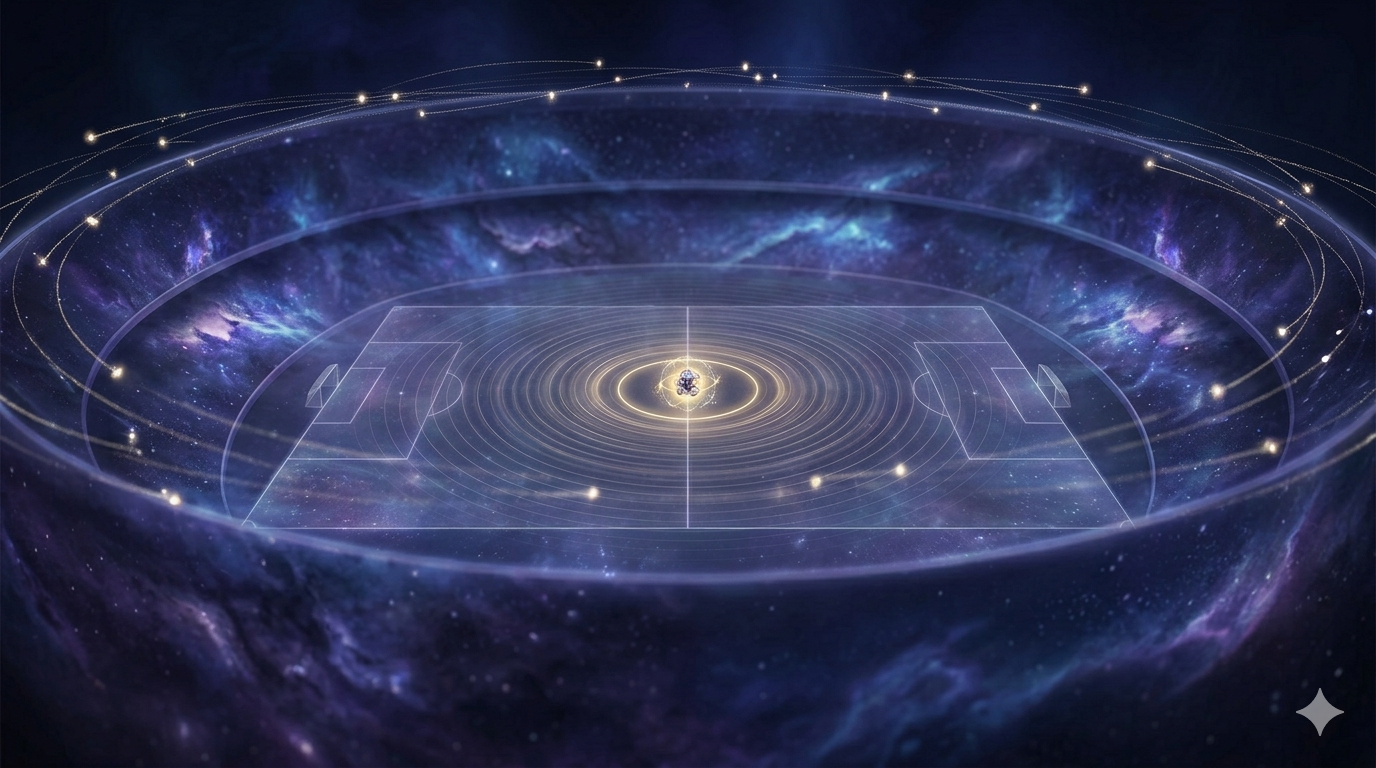
Imagine we were to blow up a single atom of a piece of gold, or even your own body, so much that the atomic nucleus became the size of a small fly. To represent the rest of the atom, we would have to place this nucleus in the center of a massive football stadium. And where would the electrons be that orbit this nucleus? They would be like tiny gnats, buzzing around the outermost edge of the very top stands.
The staggering part is: Everything in between, the entire space between the fly in the center and the gnats in the stands, is absolutely empty.
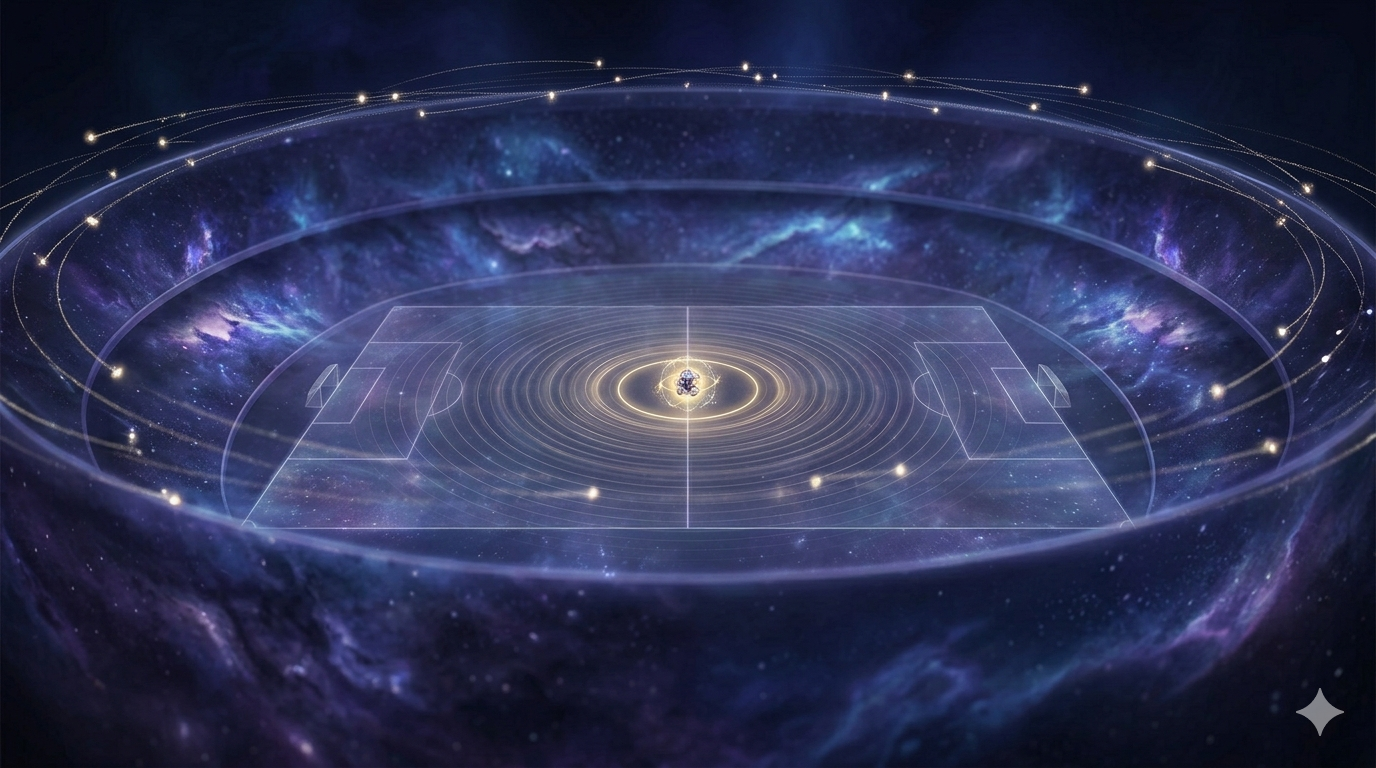
When you look at your body, you are looking at a structure that consists of 99.9999999% pure nothingness. If one were to squeeze all the "emptiness" out of every human being on Earth, the entire humanity (all 8 billion of us) would fit into the volume of a single sugar cube. We only feel so large and solid because the forces within this empty space are so incredibly powerful. We are architectural masterpieces made of empty space, held together by invisible tensions. This raises a fundamental question: If we consist almost entirely of emptiness, then what is it that truly defines us?
The Orchestra of Reality
If matter consists almost entirely of empty space, what fills that void? This is where modern physics leaves the image of "particles" behind entirely and shifts to something much more beautiful: Quantum Field Theory.
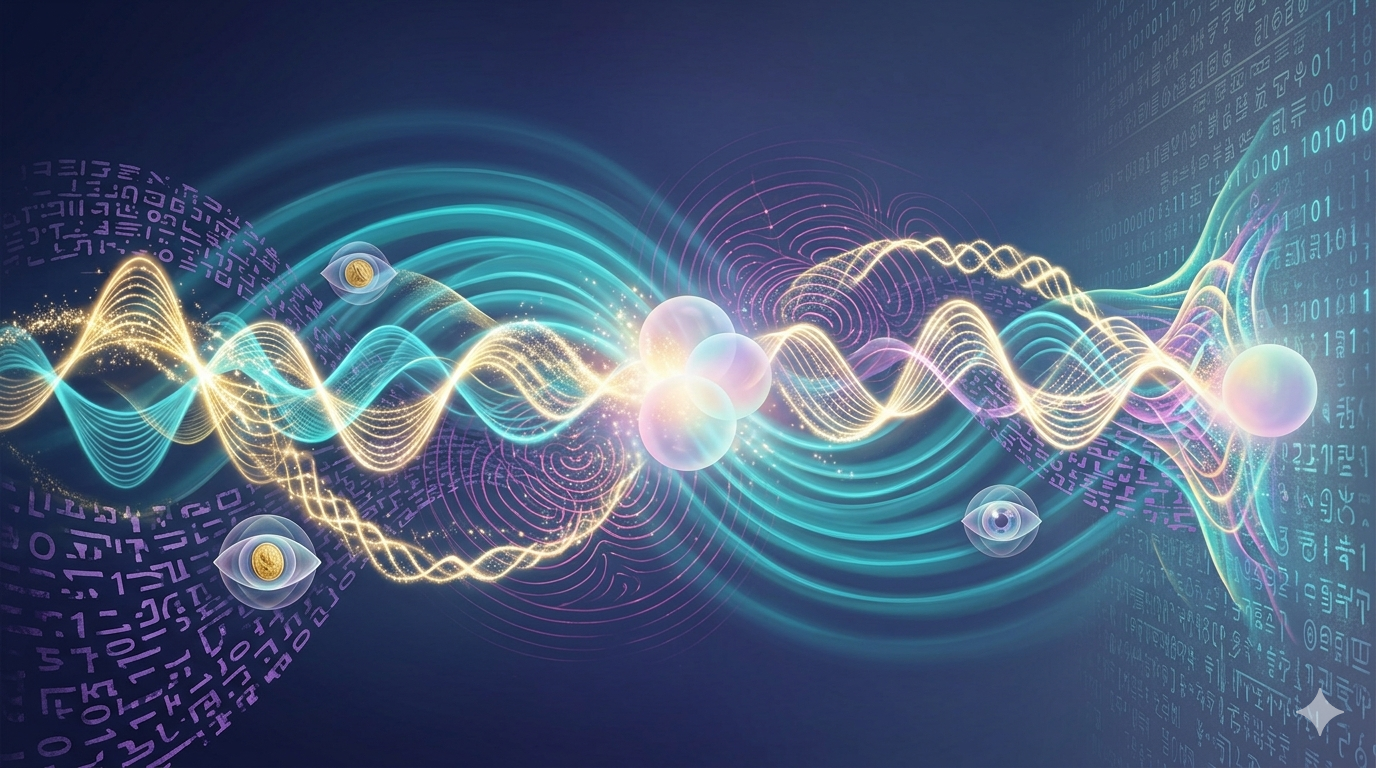
Don’t think of the universe as a box full of building blocks, but rather as an infinite ocean. In this ocean, there are no solid objects, only waves. There is a field for electrons, a field for light (photons), a field for gravity. These fields permeate everything and everyone, in every single moment.
What we call "particles" or "matter" is, in truth, nothing more than a small wave, a local excitation in one of these fields. It’s like a guitar string: when you pluck it, a sound is created. The sound isn't a "thing" you can grab; it’s a vibration of the string.
In this view, you are not an isolated lump of matter stumbling through a vacuum. You are a complex, beautiful arrangement of vibrations within these universal fields. We are like different instruments in a gigantic orchestra. When we interact, we don't "collide" like stones; we resonate with one another. We influence each other's vibrations. The universe is not an empty vessel in which things exist, the universe is the field, and we are the melodies being played within it. This perspective transforms the bleak loneliness of matter into a vibrant, shimmering interconnectedness.
The Observer as Creator
Now that we know everything is essentially made of vibrations and fields, a nearly detective-like question arises: Why do we still perceive a solid world with colors, shapes, and hard edges? Why don't we just hear the "static" of the fields?
This is where quantum mechanics enters a stage that left even seasoned physicists like Heisenberg or Schrödinger brooding: the Observer Effect. In the world of the very small, things often exist in a state of uncertainty. A particle isn't at a fixed location; it is a "probability wave" that could theoretically be everywhere at once. Only at the moment we look, when a measurement or observation takes place, does nature "decide" on a fixed state. The wave collapses into a point.
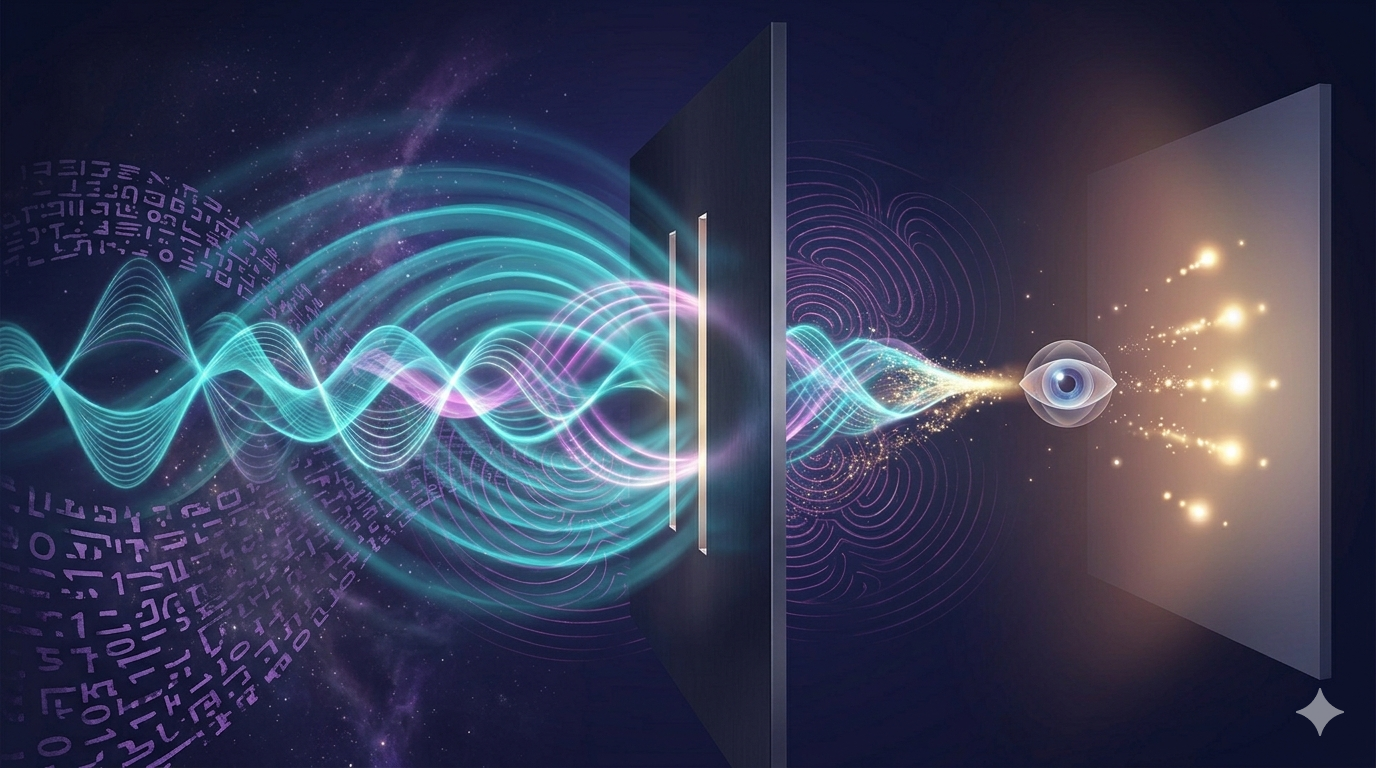
You could say: our consciousness acts like a state-of-the-art graphics renderer in a video game. The universe's engine holds all possibilities as pure code (the quantum fields), but only when we turn the camera in a certain direction is the scenery "rendered" for us, appearing as solid reality.
This means something revolutionary for our self-image: we are not passive spectators in a world that just happens "out there." We are active participants. Our consciousness is the interface that filters an experiential world out of an infinite sea of possibilities. We are the lens that first turns the light of the universe into an image.
The Grand Networking
When we view the world only materially, we often feel disconnected. There is "me" in my body, and there is "you" in yours, and in between is... nothing. But quantum physics has discovered a phenomenon that Einstein called "spooky action at a distance," which heals this sense of separation forever: Quantum Entanglement.
Scientists have found that two particles that were once connected remain fused in a way that seems to ignore space and time. If you change the state of one particle, the other reacts instantaneously, without any time delay, even if it were on the other side of the galaxy. It is as if they are still one and the same being, no matter how far apart they are.
What does this mean for us? If we consider that the entire universe originated from a single, tiny point during the Big Bang, then at that moment, everything was connected to everything else. Entanglement isn't a rare special effect in a lab; it is the invisible nervous system of the cosmos.
On the level of the fields, there is no "here" and "there." The separation we feel in everyday life is merely a property of our user interface. In the depths, we are part of an unbroken fabric. The next time you feel lonely or isolated, remember: you are connected to every star, every tree, and every other human being through the quantum level. We are not lonely islands, but waves in the same infinite ocean, dancing inseparably with one another.
The Database of the Universe
If we now accept that matter is an illusion and everything arises through vibration and observation, the ultimate question remains: How does the universe know how to vibrate? Where is the "form" of a tree or the story of your life kept?
This is where one of the most exciting theories in modern physics comes in: the Holographic Principle. To understand this, it’s best to use an image familiar to us all—the world of online video games (MMOs).
Imagine playing a character in a vast digital world. On your monitor, you see glittering armor, vast landscapes, and other players. That is your local experience. But we all know: your character doesn't actually "live" inside your monitor. It exists as a pure data set in a cloud database on a distant server. If you log out or your computer breaks, your character isn't deleted. The information about every item, every level-up, and every achievement is safely stored in the database.
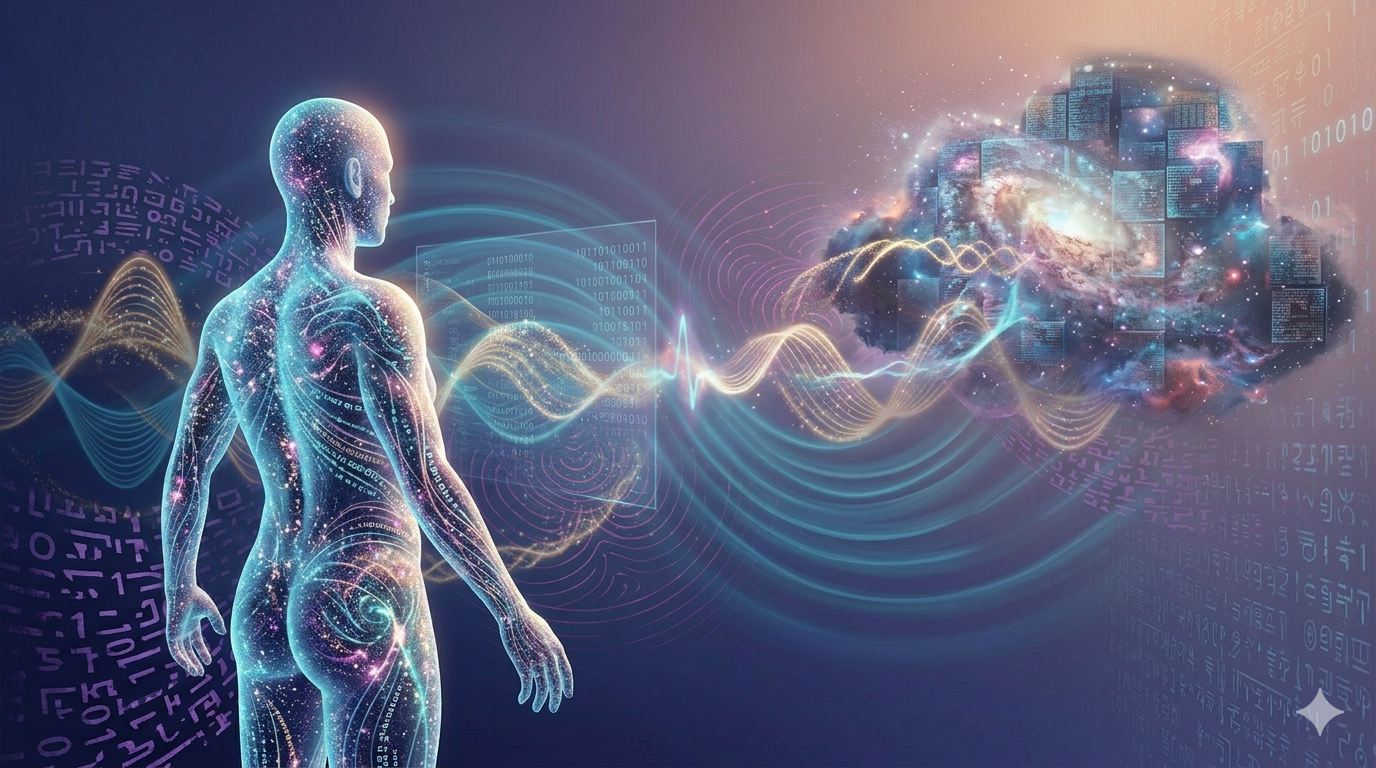
Physicists like Leonard Susskind suspect that our universe works exactly like that. Everything we experience in our three-dimensional space could be the projection of information "stored" on a surface at the outermost edge of the universe. We are essentially the high-resolution avatars of a cosmic database.
The beauty of this thought is the security it radiates: in a holographic universe, no information is lost. Every experience, every thought, and every moment of your being is anchored in the "code" of the cosmos. You are not just a temporary appearance in a cold world, but an active data set in an infinite, intelligent system that is constantly synchronizing with you.
Returning to the Everyday
After this journey through the emptiness of atoms, across vibrating fields, and all the way to the cosmic database, we now return to the point where we began: to your coffee cup, your desk, or the coin in your hand.
Perhaps these things feel different now. When you touch the surface, you now know that you are feeling a force field, an energetic greeting from the universe. You no longer see just "stuff," but recognize the incredible dynamics hidden in every millimeter of space. The world is no longer silent and gray. It is a pulsating orchestra, in which you yourself are one of the most important instruments.
The bleakness of pure matter has lost its terror. Because if the separation between "me" and "the world" is only a property of our biological user interface, it also means that we are never truly alone. We are part of a process that goes far beyond what our eyes can see. We are the way the universe perceives, explores, and celebrates itself.
You can now return to your daily routine, go to work, and handle your tasks. But you do so with the knowledge that beneath the surface of the ordinary, the infinite is whispering. You are a part of the whole, securely embedded in the architecture of reality.
The Conclusion
We have often grown accustomed to viewing the "horizon" as a line in the distance, as something that lies outside of ourselves. But as we have seen, the boundary between the visible and the invisible, between matter and spirit, is fluid.
Modern physics does not take away the wonder; it returns it to us in a much vaster dimension. Matter is not everything; it is merely the stage upon which the light of information dances. This new perspective is more than just a scientific novelty. It is an invitation to view life with more awe, more compassion, and less fear.
When we understand that we consist of stardust, connected through quantum fields and immortalized in a cosmic database, every moment becomes something sacred. We don’t have to wait until the end of our lives to grasp the depth of existence. We can choose right now to lift our gaze and realize: We are not just in the universe. We are the universe, currently learning to understand itself.
Your path is no accident, and your story is already written in the stars, or rather in the fields. Step outside, take a deep breath, and know:
You are connected. You are wanted.
And you are part of everything and everyone that ever was and ever will be.