Liquid Gold: The Real Benefits of Drinking Water for Your Body and Mind


The essence of life: Water. In this resource, we explore how mastering your hydration acts as a fundamental system-buff for your focus, energy, and long-term vitality.
Whether you prefer to read or listen, the choice is yours. You’ll find the audio version right below.
Click play and dive in at your own pace.
🎧 Listen to the article(AI-generated voiceover)
Why Hydration Is More Important Than You Think (And Why Most People Are Dehydrated)
Hand on heart, how are you feeling in this very moment? Perhaps you’ve been sitting in front of the screen for a while, and your thoughts feel a bit sluggish, like a hard drive that’s stuttering. Maybe there’s that faint throbbing behind your temples, or you notice that your patience is as thin as a single-layer interface.
In moments like these, we often search for the next big bio-hack, a third coffee, or a complex productivity tool. Yet often, the solution lies in something so fundamental that we completely overlook it: hydration.
In the rush of everyday life, we forget that we are not static machines, but highly complex biological systems running on a very specific base element: water.
In this article, I want to invite you to look at hydration in a new light. Not as a tedious chore, like “I have to drink two liters today,” but as liquid gold that keeps your entire system, from the smallest cell to your most complex thoughts, running smoothly.
We’ll explore why hydration is one of the most overlooked foundations of energy, focus, and well-being, and how to keep your inner system balanced without it ever feeling like a task.
Primal Power: Why Water Is Essential for Life and the Human Body
Before we dive deep into your biology, let’s zoom out and look at the bigger picture. Water is not just a chemical compound made of two hydrogen atoms and one oxygen atom. It is one of the most fundamental forces shaping life on Earth and the quiet architect of civilization itself.
Look at the great empires of humanity. Ancient Egypt would not have become a flourishing civilization without the annual flooding of the Nile. The Nile was not just a water source; it was the lifeline of an entire system. It provided energy, food, fertility, and transport. Wherever water flowed, life, complexity, and development followed. Where it disappeared, ecosystems and civilizations eventually collapsed.
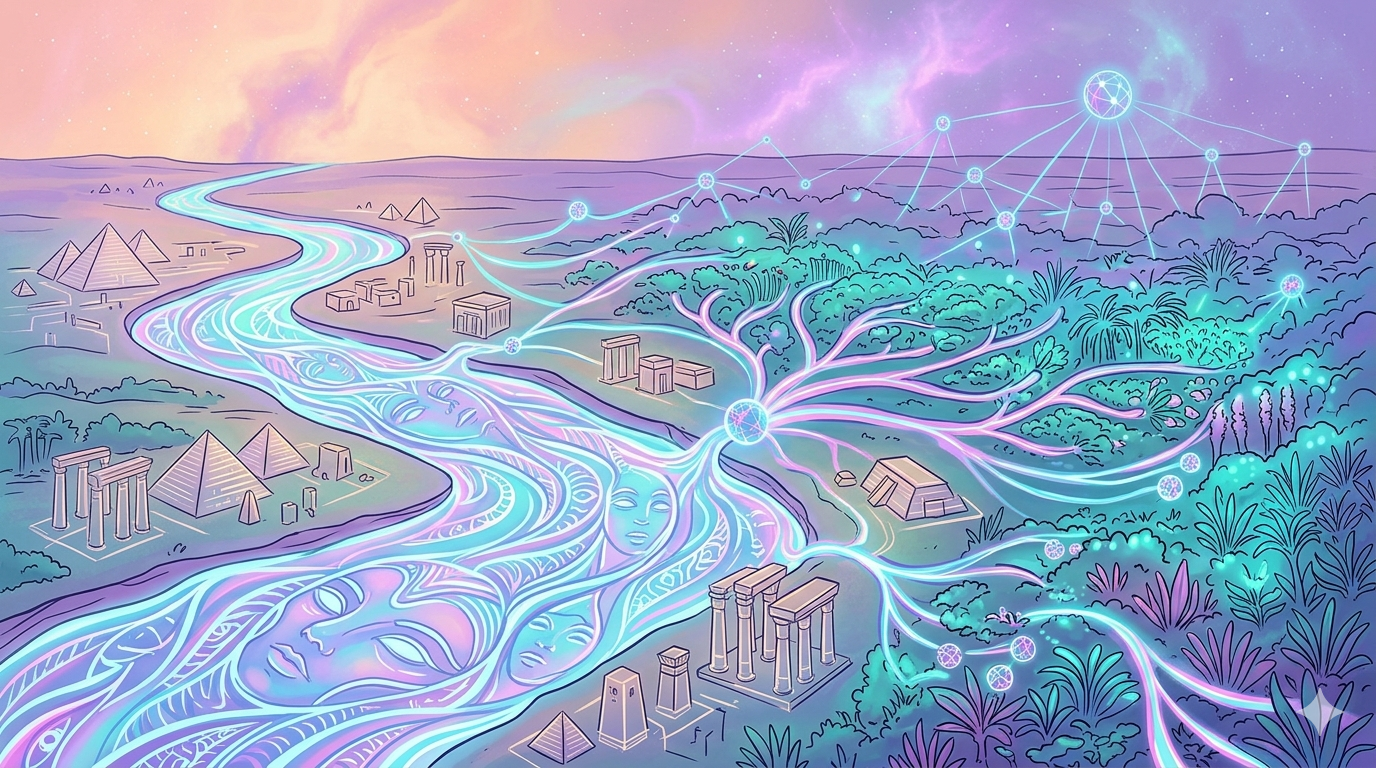
This same primal force flows within you.
We are made of approximately 60 to 70 percent water. Every glass you drink is part of a cycle that has existed for billions of years — a substance that has shaped continents, sustained life, and carried evolution forward.
You are, quite literally, a living structure of water and matter shaped by time.
It is a fascinating thought: the water in your glass has existed in different forms across Earth’s entire history. It has been part of oceans, clouds, rivers, and living organisms long before us. When you drink, you are not just consuming fluid, you are participating in a continuous cycle of life on this planet.
Seen from this perspective, water is not just a necessity. It is a biological foundation of existence itself.
When we shift our perception of water away from a simple thirst quencher toward a fundamental life element, our relationship with it changes. Drinking becomes less of a task and more of a quiet act of alignment with life itself.
How Hydration Affects Your Brain, Focus and Energy
Now that we’ve seen how water shaped worlds, let’s zoom in on your personal control center: your brain.
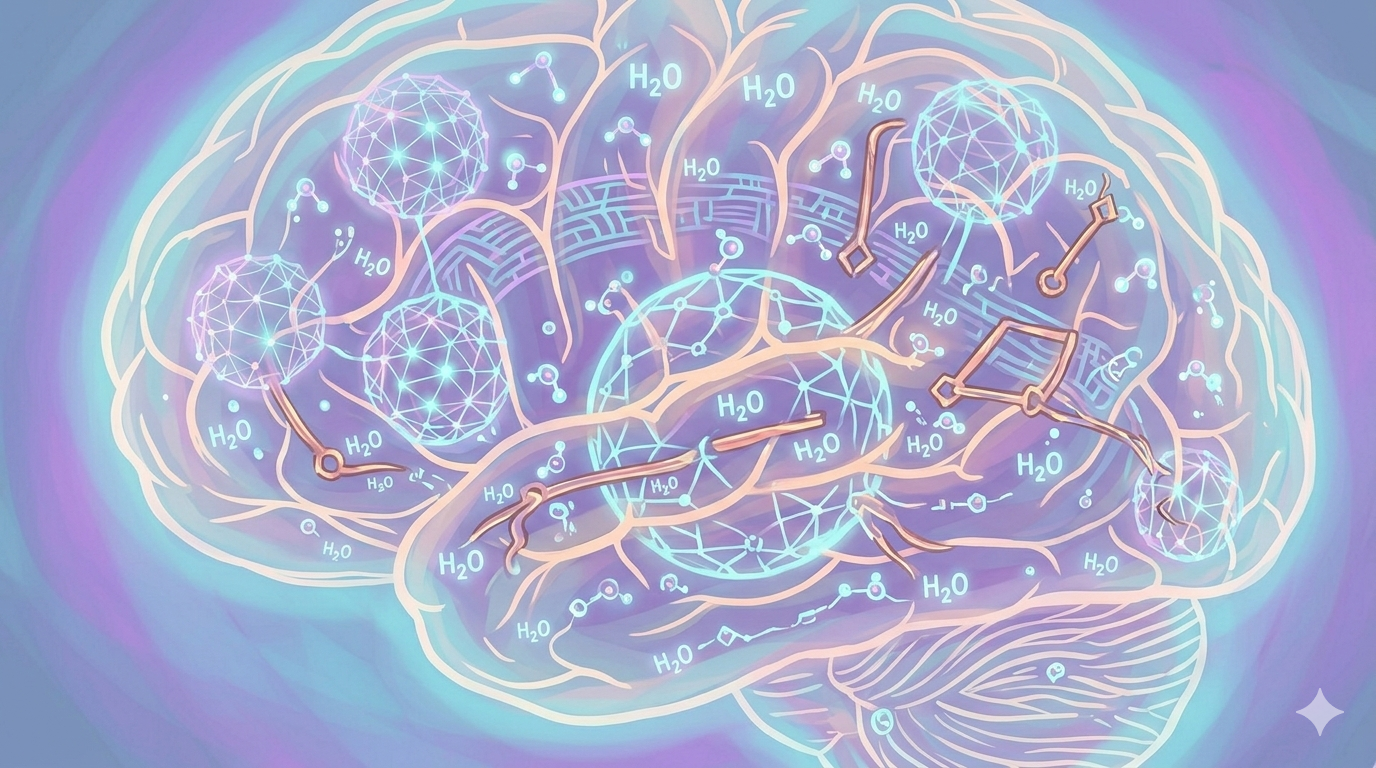
Your brain is made up of roughly 80% water, making it one of the most hydration-dependent organs in your entire body. When we talk about focus, concentration, and creativity, we are indirectly talking about hydration.
Imagine your brain as a highly sensitive information network. For signals to move efficiently from one thought to the next, your system depends on a stable internal environment. Water plays a key role in maintaining that balance, supporting both electrical and chemical processes in the brain.
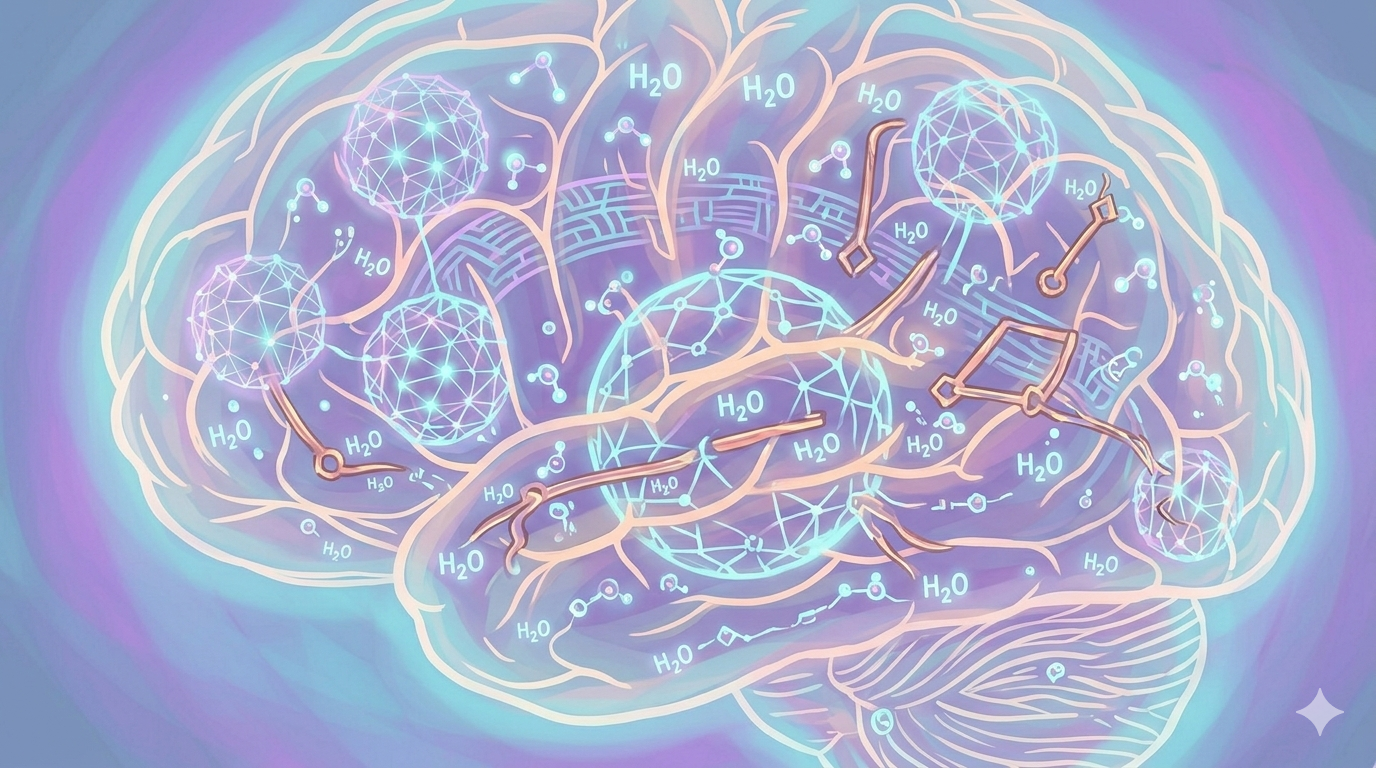
Even a small drop in hydration levels can have noticeable effects on your system.
At around 2% dehydration, people often begin to experience:
- Brain Fog: Thoughts feel slower, heavier, and less clear
- Reduced Focus: Information takes longer to process and organize
- Cognitive Strain: Headaches, irritability, and mental fatigue appear as early warning signals
These are not random issues. They are your body’s way of signaling that your internal system is running below optimal fluid levels.
In simple terms: when hydration drops, your mental performance doesn’t just slow down, it becomes less stable.
Why Minerals and Electrolytes Matter for Proper Hydration
But not all water is created equal. For proper hydration to truly work on a cellular level, your body doesn’t just need water, it also needs electrolytes. These minerals act as essential co-processors that allow fluids and electrical signals to move efficiently through your system.
You might have wondered why we talk about mineral water or why electrolytes are mentioned so often. Think of water as a pure transmission medium, and minerals like calcium, magnesium, and sodium as the elements that make real biological communication possible. Without them, the system becomes less efficient, and internal signaling slows down.
Without a sufficient level of electrolytes, your body cannot properly absorb, distribute, and regulate water, and your internal balance begins to lose stability.
- Tap Water In many regions, tap water is a highly regulated and reliable base source. It’s the simple, everyday plug-and-play solution for hydration that requires no extra thought.
- Mineral Water:
Mineral water naturally contains a varying balance of electrolytes, which can support how efficiently your body absorbs and uses water. This is often referred to as bioavailability. In daily life, this doesn’t mean you need to overthink every glass of water. A balanced diet already provides many of these minerals, and for most people, regular water is more than sufficient for proper hydration.
The important point is not to turn hydration into a complex optimization system. It’s to understand that your body depends on these dissolved minerals to maintain stable internal communication.
When the balance is right, you’re not just drinking water. You’re supporting fluid regulation, electrical balance, and system stability.
You’re not simply charging your biological batteries, you’re ensuring that your system can store, distribute, and actually use that energy efficiently.
How to Make Drinking Water Easier and More Enjoyable
Hand on heart, sometimes plain water feels a bit... “default.” We live in a world full of stimuli, and our palates are often trained for complex flavor profiles. If a simple glass of water feels too boring, it might be time for some User Mods.
Drinking shouldn’t feel like a disciplinary task, but like a small moment of enjoyment within your day.
Luckily, there are many ways to make water more appealing without relying on sugar crashes or unnecessary additives:
Drinking shouldn’t be a disciplinary measure, but a moment of enjoyment.
Luckily, there are countless ways to make water more appealing without relying on sugar crashes or unnecessary calories:
- Low-Calorie Upgrades: Brands like Holy have changed the game by offering intense iced tea-style drinks that are completely sugar-free. Other providers like Waterdrop or Air Up use clever approaches such as micro-drinks or scent technology to create a taste experience while your body still receives pure hydration. It’s like giving your water a new “skin,” while the core engine remains clean.
- Natural Infusions: If you prefer it analog, try infused water. A few slices of cucumber, fresh mint, frozen berries, or a splash of lemon can transform plain water into something more enjoyable and refreshing. These additions don’t change hydration itself, they simply make the experience more pleasant and visually engaging.
Your goal is not perfection, but consistency through enjoyment. When water tastes good to you, drinking stops being a conscious decision and becomes an automatic habit that supports your system effortlessly.
How Much Water Should You Drink Per Day (And How to Build the Habit)
Before we talk about habits, let’s answer the question most people actually came here for: how much water should you drink per day?
A simple answer to how much water you should drink per day is around 2 to 2.5 liters per day for most adults. Another common guideline is about 30–35 ml of water per kilogram of body weight.
But here’s where it gets more human than mathematical. Your actual needs depend on your environment, your activity level, and even how your body feels in a given moment. A hot day, a workout, or intense mental focus can all increase your demand significantly.
Instead of chasing a perfect number, think of these values as a reliable baseline, not a strict rule. Your body isn’t a machine that needs exact input. It’s a dynamic system that communicates with you constantly.
A good practical indicator is surprisingly simple:
If you rarely feel thirsty, your energy is stable, and your urine is light in color, you’re likely in a good range.
Hydration isn’t about perfection. It’s about staying in flow. The best software is useless if it isn't installed. So, how do we integrate optimal hydration into your daily operating system without you constantly having a "notification" in the back of your mind?
We work with gentle routines instead of iron will.
- Event Triggering: Couple drinking with fixed events in your day.
- Boot-up: A large glass of water right after waking up flushes the night out of your cells.
- Task Check: A glass of water after every finished meeting or every completed task on your list.
- The Closed Loop: Every time you get a coffee or walk into the kitchen, a glass of water goes with you.
- Hardware Visuals: We react strongly to visual stimuli. Place an aesthetic glass carafe or a high-quality water bottle directly in your field of vision on your desk. It acts like a permanent icon on your physical desktop, gently reminding you: "Hey, an upgrade is waiting for you here."
- Digital Support: If your focus is so deep that you forget everything around you, use technology. There are wonderful hydration apps that remind you with a discreet notification to briefly press the "pause button" and take a sip. They help you find the rhythm until your body sends the signal all on its own again.
Conclusion: Flow with Your Full Potential
Water is so much more than just a chemical formula. It is the essence that has sustained civilizations, that keeps your thoughts fluid, and that gives your body the strength to explore the world.
When you learn to regularly gift your body this liquid gold, you may notice the mental fog lifting and your system gradually returning to a state of balance and clarity. Give water a real chance in your life. Be patient with yourself, explore different “mods,” and find your own natural flow.
You are a being of water and light, constantly shaped by the systems within and around you. When your inner balance is maintained, everything else begins to move with more ease. A fluid system is a powerful system.
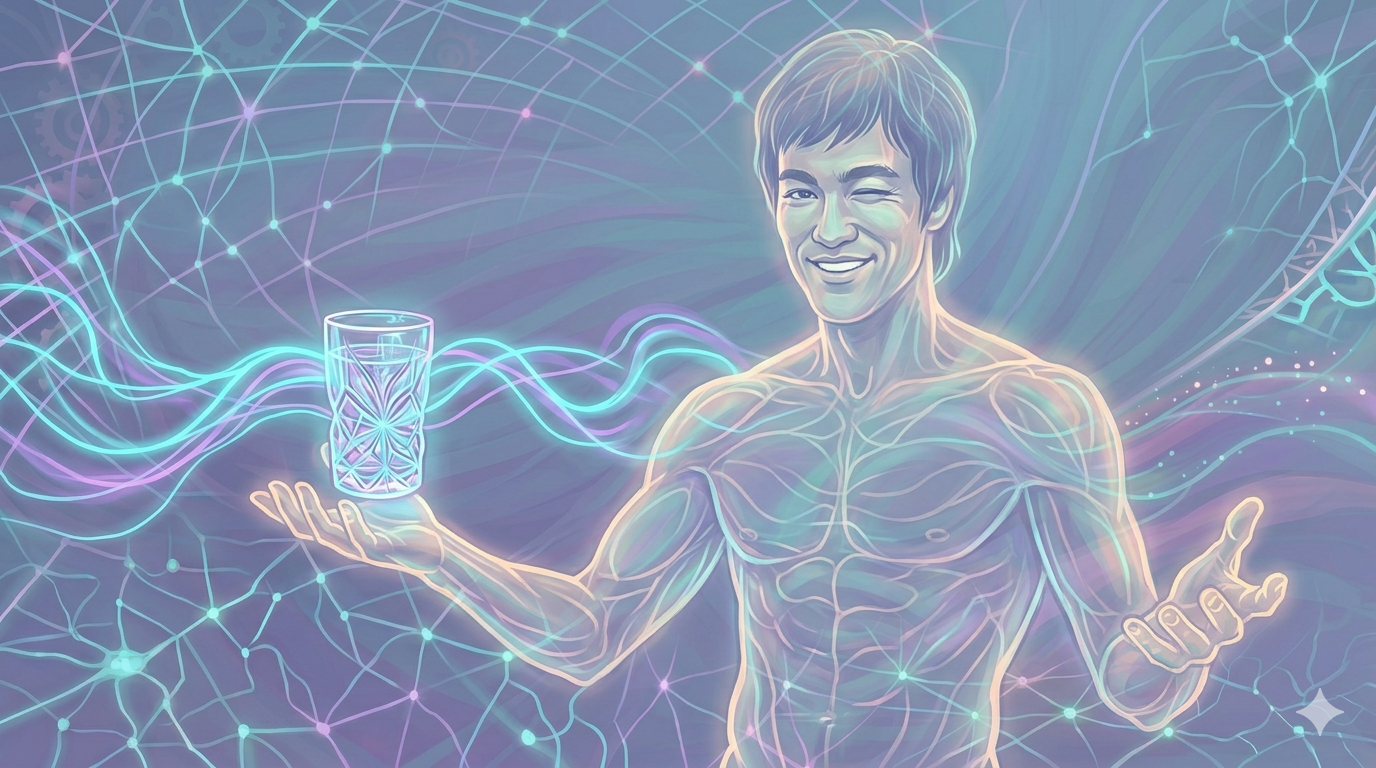
And as a great master once said...
"Be water, my friend." 🌊