
The powerful synergy of 5 Japanese Philosophies

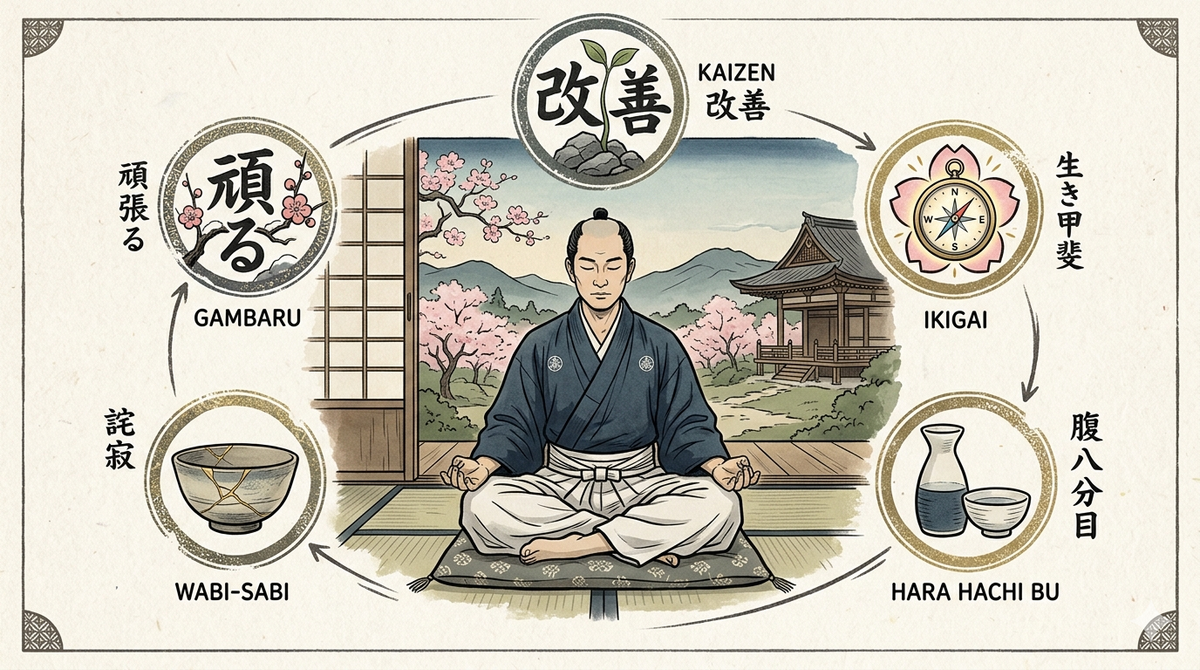
Discover how five ancient Japanese philosophies combine to unlock your full potential and transform your everyday life.
🎧 The Audio Experience
Whether you prefer to read or listen, the choice is entirely yours.
Click play and dive in at your own pace.
🎧 Listen to the article(AI-generated voiceover)
Have you ever felt like you’re running against an invisible wall? You know exactly what you want to change in your life. Perhaps it’s the longing for a healthier body, the desire to heal a deep, almost lost connection with a loved one, or the dream of finally finding the professional fulfillment that has eluded you until now.
You start with fire in your heart. You forge big plans, buy equipment, and set deadlines. But after a short time, reality strikes back. Motivation evaporates, and you’re left with the bitter taste of failure. You begin to believe that certain changes just aren’t meant for you. That you are "just like that."
But here is the truth: You are not the problem. Your approach is. We live in a culture of "instant change" that ignores our human nature. However, there is a system so deeply rooted in Japanese culture that it feels almost like a force of nature. It is a path of gentleness, patience, and unstoppable consistency. These five philosophies, Kaizen, Ikigai, Hara Hachi Bu, Wabi-Sabi, and Gambaru, are not just mere tips. They are a foundation for a completely new you.
Before we take the first step, allow yourself one thing: Let go of the pressure. You don't have to implement this article today. You don't have to be perfect tomorrow. We are walking this path together, at your own pace.
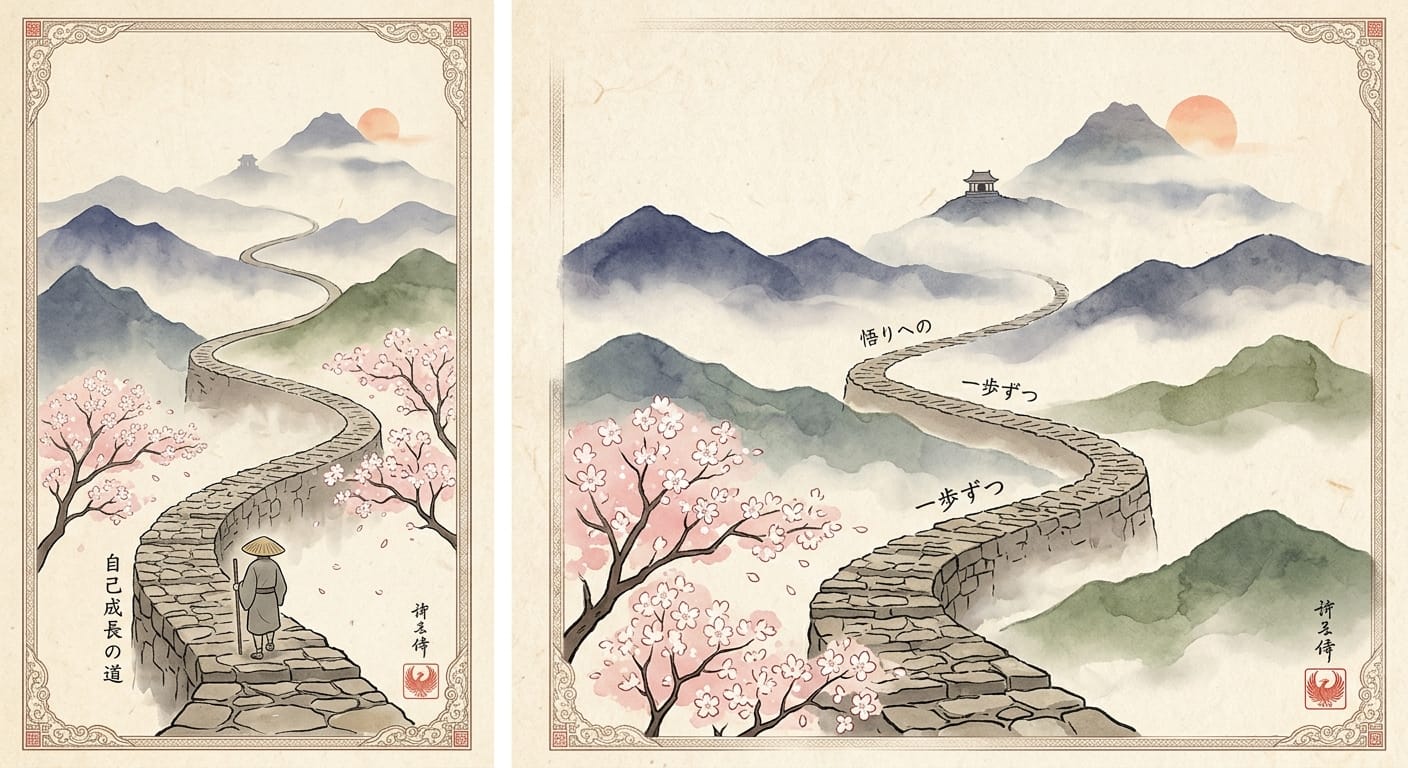
Chapter 1: Kaizen The Silent Revolution of One Percent
The History: From Reconstruction to Global Power
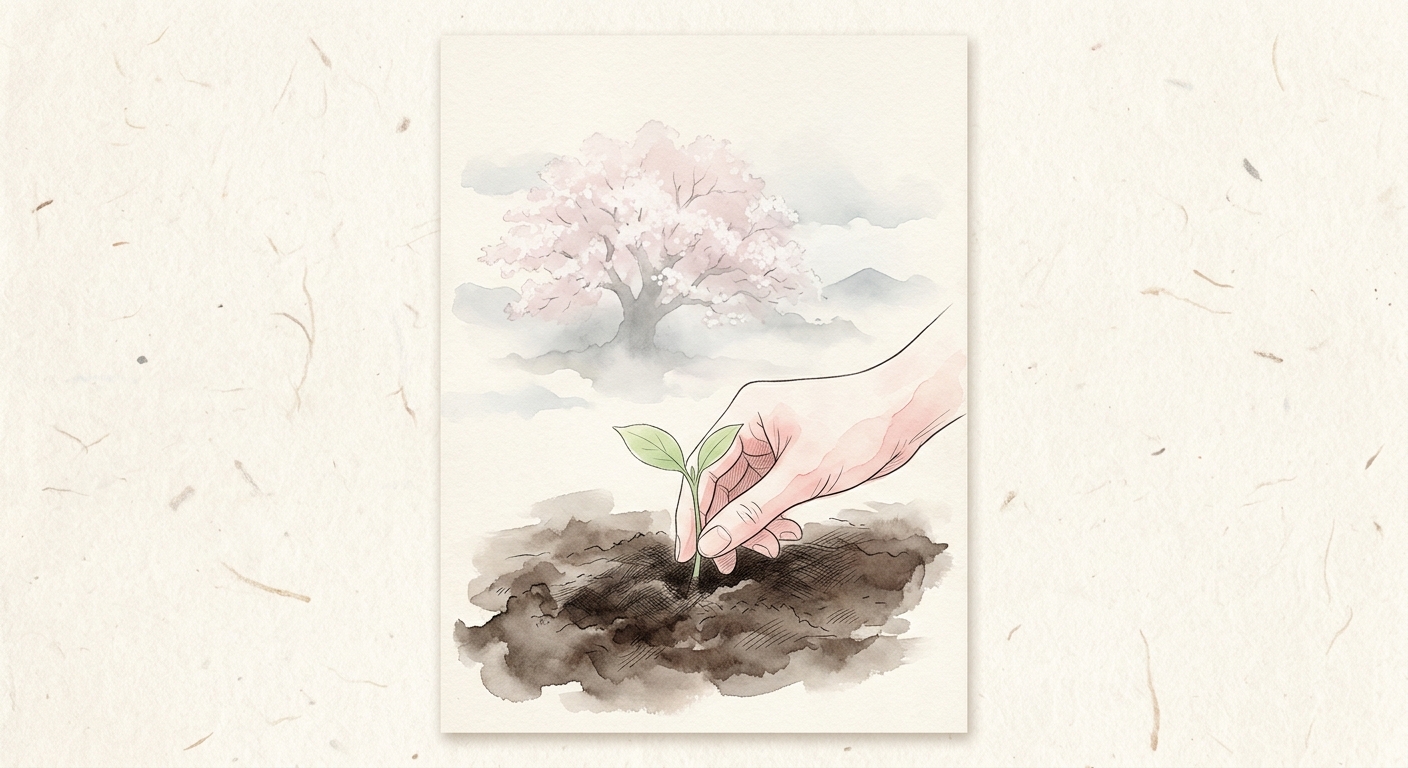
The story of Kaizen is a story of triumph rising from the ashes. After World War II, Japanese industry lay in ruins. Instead of looking for a single "miracle solution," companies like Toyota began to implement a system based on the participation of every single employee. The idea was simple: make one tiny thing a little bit better every day.
They didn't look for a 100% improvement, but for 100 improvements of 1% each. The result? Within a few decades, Japan became a technological superpower. Kaizen proved that the sum of small, almost invisible acts is more powerful than any heroic individual victory.
The Psychology: Why Your Brain Loves Kaizen
Why do we fail at big resolutions? Our brain possesses an alarm system, the amygdala. As soon as we plan a massive change ("Starting tomorrow, I'll go to the gym for two hours every day!"), the amygdala interprets this as a threat to our habitual safety. It triggers fear, leading to procrastination and resistance.
Kaizen bypasses this defense mechanism. A step so small that it seems almost ridiculous doesn't trigger fear. It "flies under the radar." Your brain stays relaxed while you are already busy laying new neural pathways.
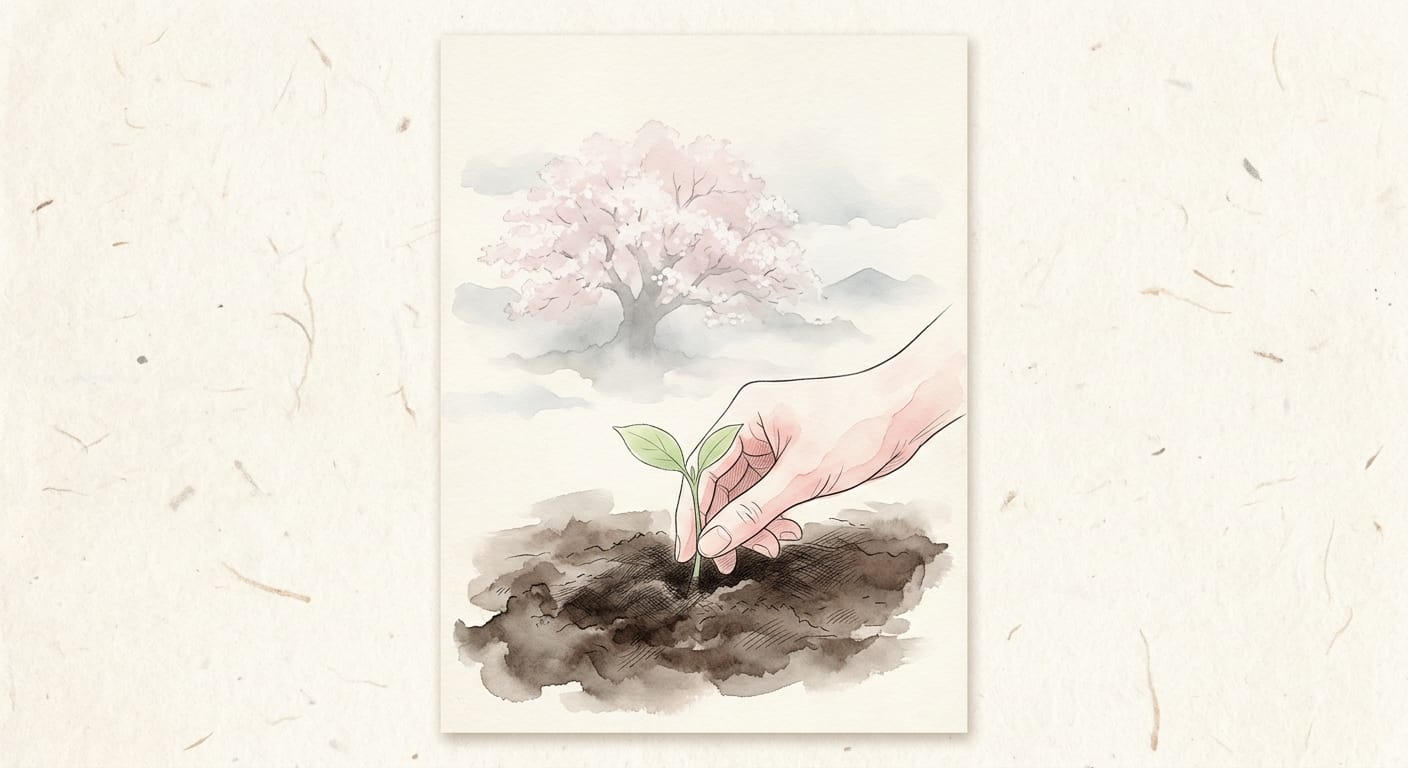
Application Areas: Where Kaizen Moves Mountains
- Healing Relationships: Often we think we need a long, heavy "clarifying talk" to save a relationship. Kaizen suggests a different path. Start by incorporating a small gesture of appreciation every day for two weeks that takes less than 30 seconds. A small note on the fridge, a quick "thanks for cooking," or a text in between. It’s not about solving the problem immediately, but about softening the "ground" of the relationship again.
- Health Transformation: The success stories of Kaizen in health are legendary. People have shifted their entire identity from "couch potato" to athlete by simply putting on their running shoes and walking up and down the living room for five minutes for the first two weeks. Sound useless? It’s not. In those five minutes, you aren't training muscles; you are training your discipline-structure. After two weeks, the resistance is gone, and you can increase to ten minutes.
- Professional Excellence and Dreams: Want to learn a new language to travel the world? Most start with language courses they quit after three weeks. Kaizen means: learn one single vocabulary word while brushing your teeth. Only one. If you do that for a year, you’ve learned 365 words, more than most people retain in a lifetime of a foreign language.
- Spiritual and Mental Clarity: Instead of meditating for an hour, try Kaizen-Mindfulness. Pause three times a day for exactly three breaths. Feel the air flowing in and out. These 30 seconds a day chemically alter your stress levels because they interrupt the constant flow of your thoughts.
The Kaizen Vow
Kaizen requires humility. You must be willing to admit that you can't make the big jump (yet) and settle for the "ridiculously small" step. But that is exactly where the power lies. Whoever walks slowly goes the furthest because they never stop.
Your Reflection: If you are honest with yourself today, which area of your life feels the heaviest? And what would be a step in this area that is so small it’s impossible to fail?
Chapter 2: Ikigai The Alchemy of Life Joy
If Kaizen is the "How" of our change, then Ikigai is the "Why." The word is composed of Iki (life) and Gai (value or sense). It describes nothing less than the feeling that life is worth living. It is the answer to the existential question that haunts us late at night or in moments of emptiness: What for?
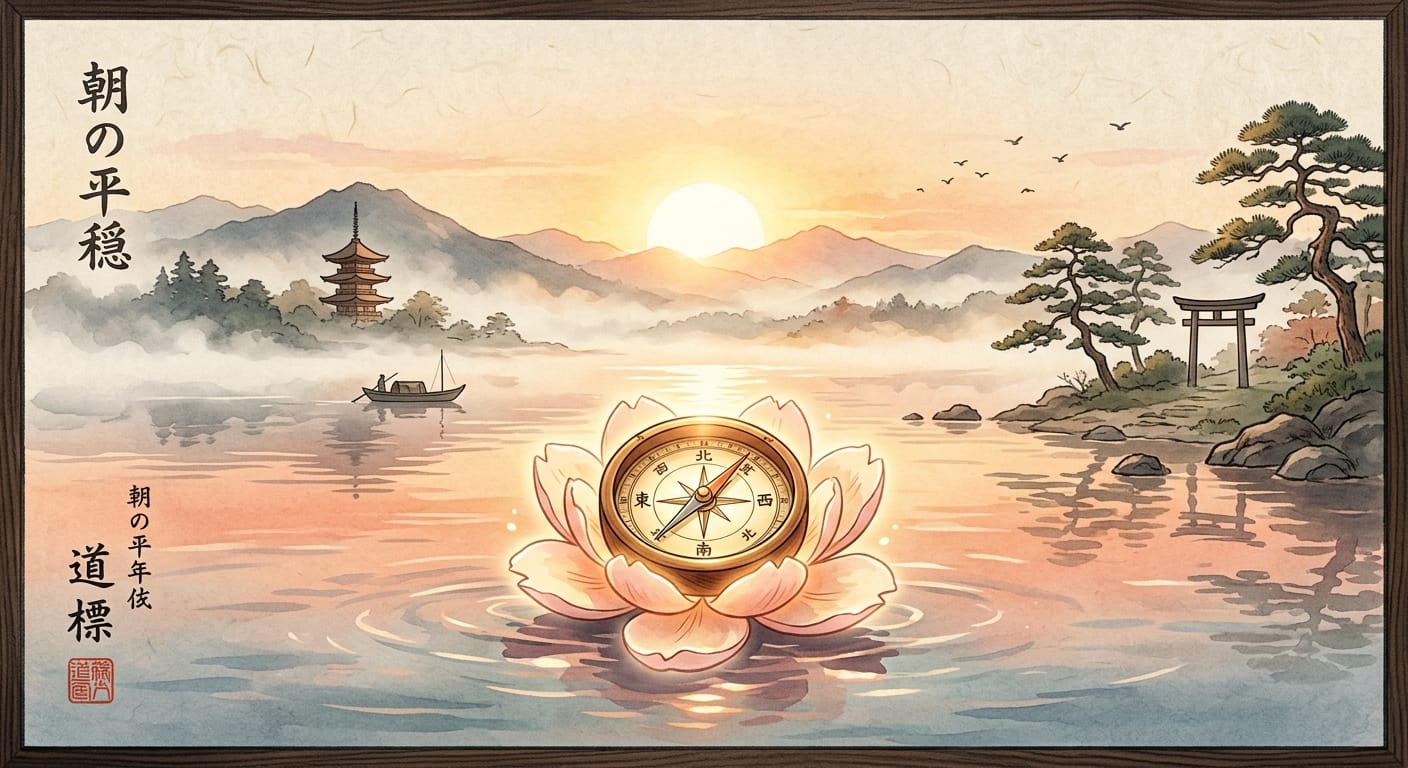
The Origin: More Than Just a Job
In the West, Ikigai is often shown as the intersection of what you love, what you are good at, what the world needs, and what you can be paid for. But in Japan, specifically in the long-lived community of Okinawa, Ikigai is much more modest and yet more powerful. It doesn't have to have anything to do with your career. An Ikigai can be the scent of the first coffee in the morning, tending a garden, or the deep connection to a loved one.
It’s not about finding the "one big purpose" like hidden treasure. It’s about cultivating a source of joy in the here and now that carries you through the storms of life.
Psychological Impact: A Shield for the Soul
Research shows something amazing: People with a pronounced Ikigai have a significantly lower risk of cardiovascular disease. Why? Because a clear sense of purpose lowers the stress hormone cortisol. When you know why you are here, your system doesn't perceive challenges as threats, but as obstacles on a path you chose. It is a biological shield against the feeling of meaninglessness.
Ikigai in Different Areas of Life
- Ikigai in Partnerships and Family: Often we try to improve relationships through "work." But what if your Ikigai in the family is simply being the "guardian of lightness"? Your purpose could be to be the person who provides a smile after a hard day. If you accept this role as your Ikigai, enduring minor frictions suddenly makes sense. You aren't fighting your partner; you are nurturing your mission.
- Ikigai at Work and Career: Many hate their jobs because they see no meaning in them. Ikigai teaches us to shift focus. A hospital cleaner who sees their Ikigai in creating a germ-free environment for healing experiences a completely different satisfaction than someone who "just cleans." Search for the contribution you make. Who do you support? Whose life do you make a bit easier? That is the spark of meaning in the daily routine.
- Ikigai for Personal Health: Losing weight or exercising is often a torture because the goal is abstract. Connect it to your Ikigai. If your Ikigai is traveling and discovering distant cultures, then physical fitness is the tool that unlocks that world for you. You aren't training for the scale; you are training for your next adventure. The effort gets a face and a goal.
- Ikigai in Hobbies and Dreams: A hobby doesn't have to be productive. If you love playing video games or studying complex philosophies, that can be your Ikigai because it sharpens your mind and gives you joy. It’s the area where you experience "flow", that state where time stands still. These moments are not a waste of time; they are gas stations for your soul.
The Pitfalls: Searching for the "One Thing"
The biggest mistake with Ikigai is the pressure that it must be something gigantic. Many people feel worthless because they haven't found "their destiny" yet. But Ikigai is fluid. It can change throughout life. In your 20s, it might be building your career; in your 40s, your children; and in old age, the wisdom you pass on.
Ikigai is not a goal on the horizon; it is the sun that warms you during the hike.
Your Path to Ikigai
To uncover your Ikigai, you don't have to meditate until you are enlightened. Start small:
- Observation: When was the last time you forgot time?
- Resonance: Which topics make your heart beat when you talk about them?
- Impact: Where do you feel needed, even if it's just a small thing?
Your Reflection: If all obligations and pressure fell away tomorrow, what is the one thing you would still want to do, simply because it feels "right"? That is the trail to your Ikigai.
Chapter 3: Hara Hachi Bu The Wisdom of Eighty Percent
We live in an era of maximization. We want 100% performance at work, 100% perfection in appearance, and we eat until we feel "stuffed." But this greed for the maximum often leads to a system crash: burnout, inertia, and a feeling of being overloaded. This is where Hara Hachi Bu comes in.
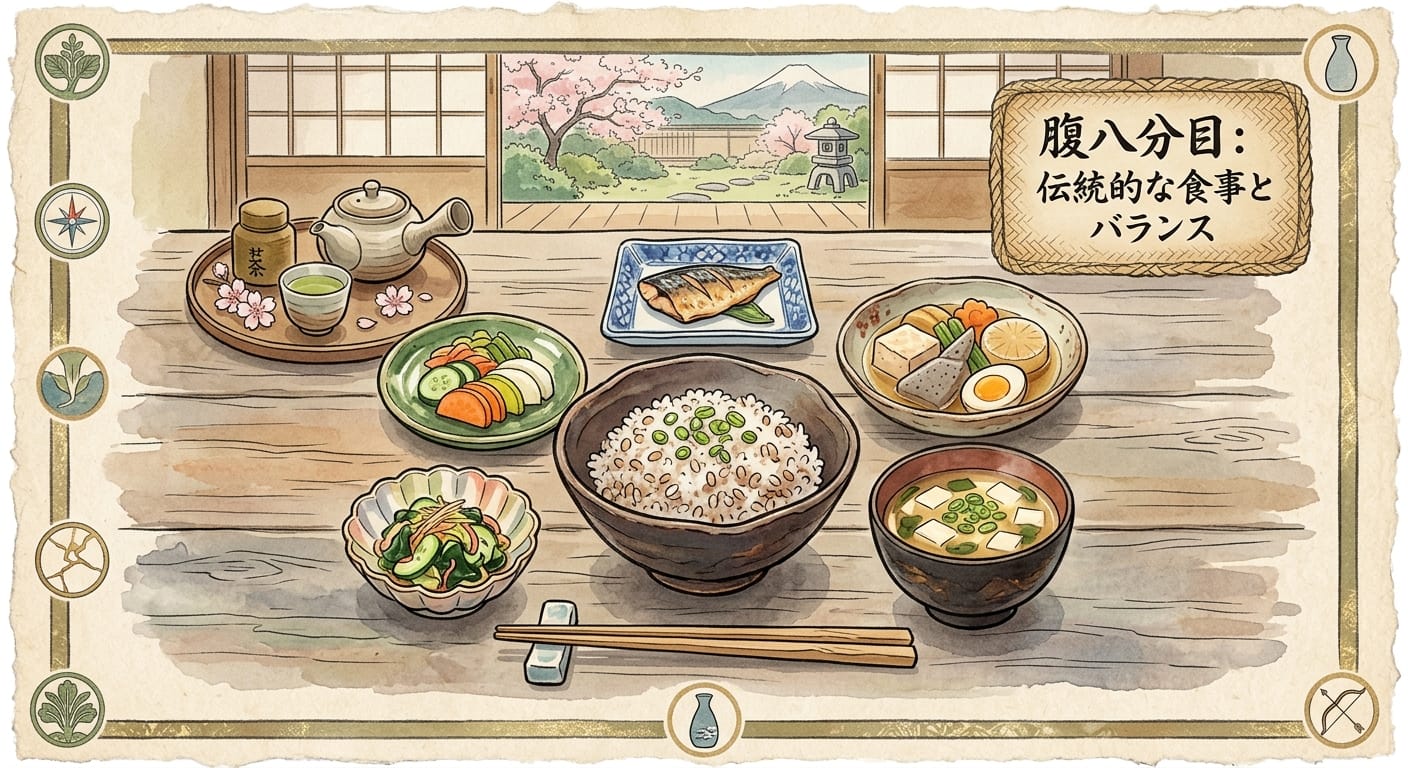
The Origin: The Heritage of Centenarians
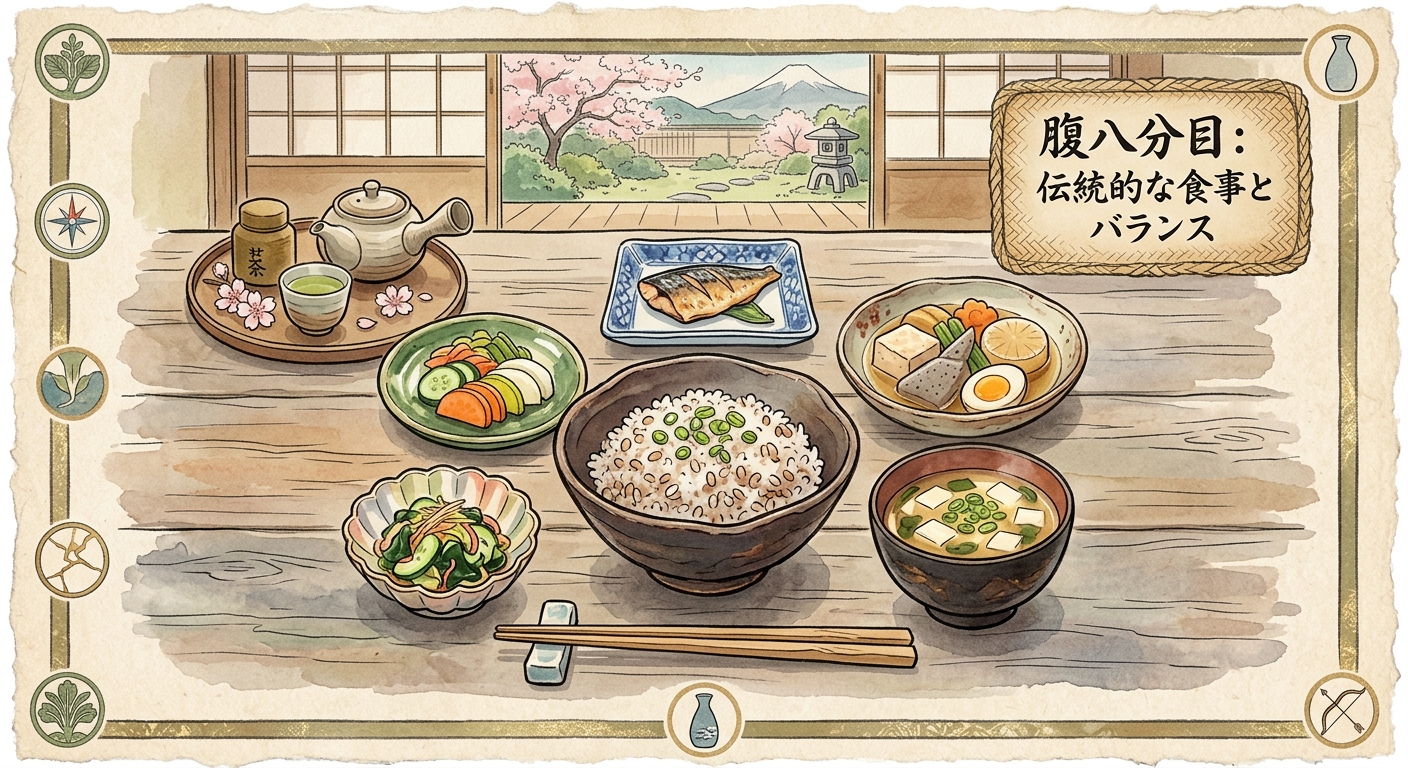
This teaching comes directly from the villages of Okinawa, one of the "Blue Zones" of the Earth, where people live to be over 100 significantly more often, and in excellent health. The sentence "Hara hachi bun me" literally means: "Belly eight-tenths full."
Historically, this was a necessary practice in times of scarce resources, but Okinawans quickly realized that this moderation is the key to lifelong vitality. It is not a sacrifice out of lack, but a conscious decision for one’s own life force. They don't eat to be full, but to have enough energy for their tasks and their community.
Biological Logic: The Delayed Signaler
Why are exactly 80% so crucial? Our body has a fascinating but slow communication system. When we eat, it takes about 15 to 20 minutes for the stretch receptors in the stomach and the satiety hormones (like leptin) to signal the brain: "We've had enough."
Whoever eats until they feel full has usually already passed the point of no return. The stomach is overstretched, blood rushes into the digestive tract, and we land in the famous "food coma." Hara Hachi Bu teaches us to slow down so we don't miss the moment of optimal satiety.
Transfer: Hara Hachi Bu as a Life Principle
This philosophy can be applied to far more than just nutrition. It is a universal law of efficiency.
- Emotional Capacity in Relationships: Often we make the mistake of wanting to clarify everything in an argument until we are emotionally exhausted. We talk until we are "overfull" with frustration and words. Hara Hachi Bu in communication means ending a conversation when you are at 80% of your stress limit. You leave room for reflection and calming down. This keeps the relationship alive instead of suffocating under the weight of unresolved heaviness.
- Work and Productivity: Many of us work until we are completely burned out in the evening. We give 110%. But the next day we pay the price with a lack of concentration. If you end your work at 80% of your daily energy, you still have 20% left to be a good partner, a present parent, or simply a relaxed person. These 20% are your "reserve for life quality."
- Learning and Hobbies: When you learn a new skill, like an instrument or a language, we tend to overextend ourselves. Hara Hachi Bu here means: stop practicing as long as it's still a little bit fun. If you leave the table with a feeling of "I could actually do a bit more," the anticipation for the next session is guaranteed. You prevent the mental resistance that arises when a hobby becomes a burden.
- Digital Consumption: We often scroll through social media until our heads feel heavy and full. We consume information beyond the measure we can process. Hara Hachi Bu invites you to put the phone away when you notice your curiosity is satisfied but your mind is still clear.
The Practice: How to Find the 80%
Hara Hachi Bu requires a deep return to body awareness. In a world that constantly distracts us, that is a real challenge.
- The "Check-in" Pause: Pause in the middle of a meal or a task. Take a deep breath. Ask yourself: "Would I be at the end if I stopped now?" If the answer is "No, I could still do more," you are probably exactly at the point where you should stop.
- Smaller Vessels: In Okinawa, meals are often served in many small bowls. The eye sees variety, but the quantity remains controlled. Transfer that to your daily life: set smaller time windows for tasks.
- Slowness as a Tool: Whoever runs fast doesn't see the landscape. Whoever eats slowly or works slowly feels the saturation limit much more clearly.
Your Reflection: In which area of your life do you tend to stuff yourself until "overflowing", be it with food, work, or information? How would it feel to consciously stop at 80% today and spend the rest of the day with this gained lightness?
Chapter 4: Wabi-Sabi Liberation from the Dungeon of Perfection
In a world that constantly confronts us with smoothed faces, flawless resumes, and the illusion of a "perfect life," Wabi-Sabi acts like a liberating breath of fresh air. It is the Japanese understanding of aesthetics that finds beauty where we often least expect it: in the imperfect, the transient, and even the broken.
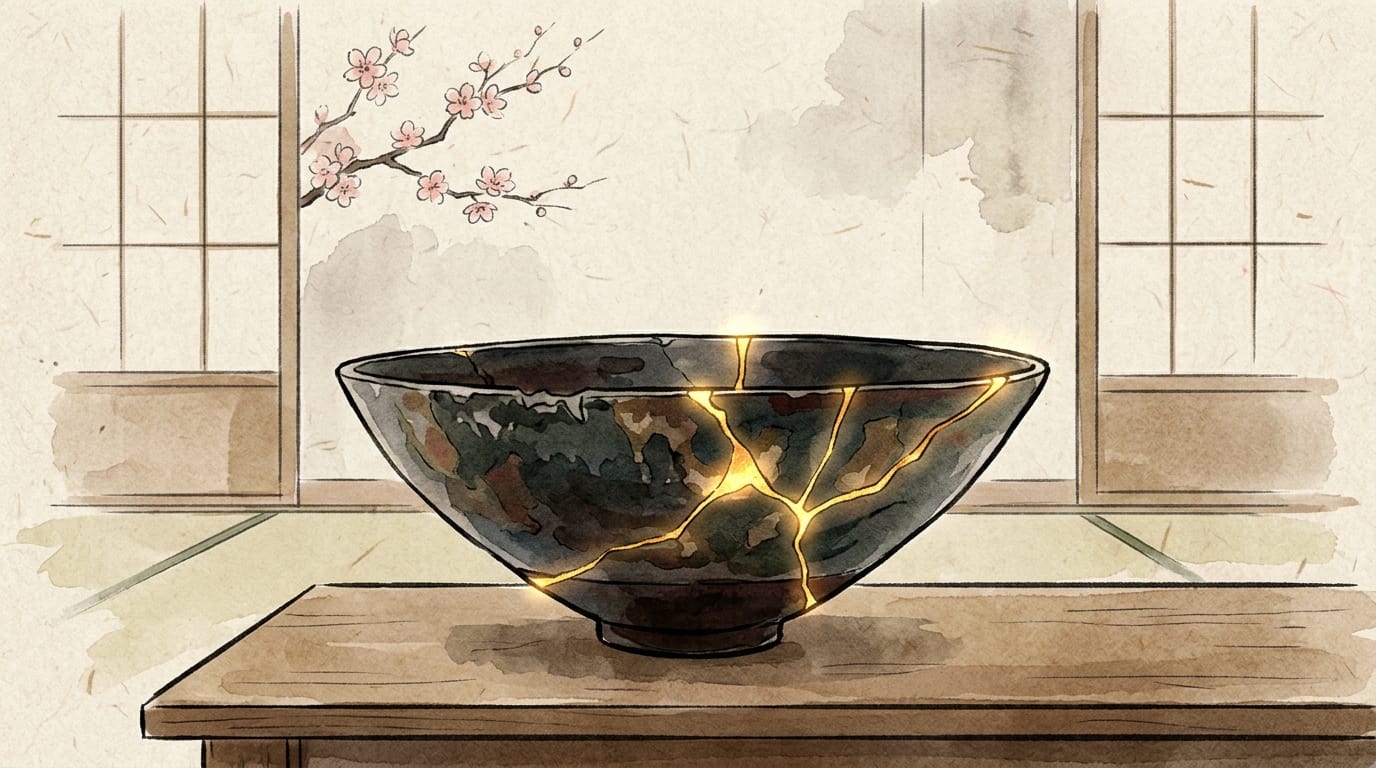
The Origin: A Teahouse, a Broken Cup, and Gold
The roots of Wabi-Sabi lie deep in Zen Buddhism. While in the West symmetry and flawlessness were the ideal, Japanese tea masters developed a completely different view.
A famous legend tells of a young man who was supposed to sweep his master's garden. He swept it perfectly until not a blade of grass was askew. But before he was finished, he shook a tree so that a few autumn leaves fell randomly on the ground. Only now, said the master, was the garden "perfect", because it reflected the honest, unpredictable nature of life.
From this also arose the art of Kintsugi: When a valuable tea bowl breaks, the shards are glued with a special lacquer mixed with real gold powder. The crack is not hidden, but refined. The bowl is more valuable after the break than before because it has a history. It "survived."
Psychological Healing: The End of Self-Optimization
Why do we suffer so often from our own standards? Perfectionism is basically a form of fear, the fear of not being good enough if you make a mistake. Wabi-Sabi breaks open this cage. It teaches us that a life without scars, setbacks, or "ugly" moments doesn't exist. Whoever demands perfection demands the impossible and will inevitably be unhappy.
Wabi-Sabi is the permission to be human. It is the realization that your "mistakes" are not what devalue you, but what make you unique and tangible.
Wabi-Sabi in Application: Gilding Your Scars
- Self-Love and Your Own Body: We look in the mirror and see wrinkles, scars, or stretch marks as defects. Wabi-Sabi regards these signs as "maps of your life." Every wrinkle tells of a laugh or a worry you've survived. When you see your body through the lens of Wabi-Sabi, you stop maintaining it like a machine that must never break. You begin to treat it like a beloved heirloom that gains character through use.
- Forgiveness in Personal Development: This is the core point for your change. If you try to build a new routine and fail one day, that day is your "crack in the bowl." A person without Wabi-Sabi throws the bowl away ("It doesn't matter now anyway"). A person with Wabi-Sabi takes the golden glue of self-knowledge and continues the next day. The relapse makes you wiser because you learn how to deal with it in the future. Your path to success only becomes valuable through failure.
- Depth in Partnership: Nothing kills love faster than the expectation that the other must be perfect. Wabi-Sabi in a relationship means not only tolerating the other's quirks and flaws but understanding them as part of their beauty. A couple that has endured heavy crises and put themselves back together has a "golden seam" that holds much stronger than a love that has never been tested.
- Creativity and Courage for Chaos: Many people never start painting, writing, or founding a business because they are afraid the result won't look professional enough. Wabi-Sabi encourages you to love the "asymmetry" of your beginnings. The first uncertain steps have an honesty that no high-gloss end product possesses.
The Practice: Sharpening Your Gaze
Wabi-Sabi cannot be forced; it can only be allowed.
- Letting Things Age: Look at old objects in your home. The worn spot on the armchair, the yellowed book. Feel the story behind it instead of thinking about a replacement.
- The "Good Enough" Rule: When you notice yourself getting lost in details to make something perfect, stop. Ask yourself: "Does it already possess enough Wabi-Sabi?" Often the imperfect is much more alive.
- Radical Honesty: Stand by your mistakes. If you did something wrong, don't hide it. By dealing with it openly, you give others permission to also be imperfect. That creates real connection.
Your Reflection: Is there a "crack" in your life, perhaps a mistake from the past or a trait about yourself, that you are ashamed of? How would your feeling change if you filled this crack with gold today? If you viewed it not as a blemish, but as proof of your strength and your story?
Chapter 5: Gambaru The Art of Unwavering Dedication
In our modern world, "perseverance" is often equated with gritting one's teeth, stress, and self-sacrifice. We think of burnout and overwhelm. But the Japanese principle Gambaru has a completely different quality. It literally means "to remain persistent" or "to hold one's place." It’s not about blind obedience to a goal, but about respect for one's own decision.
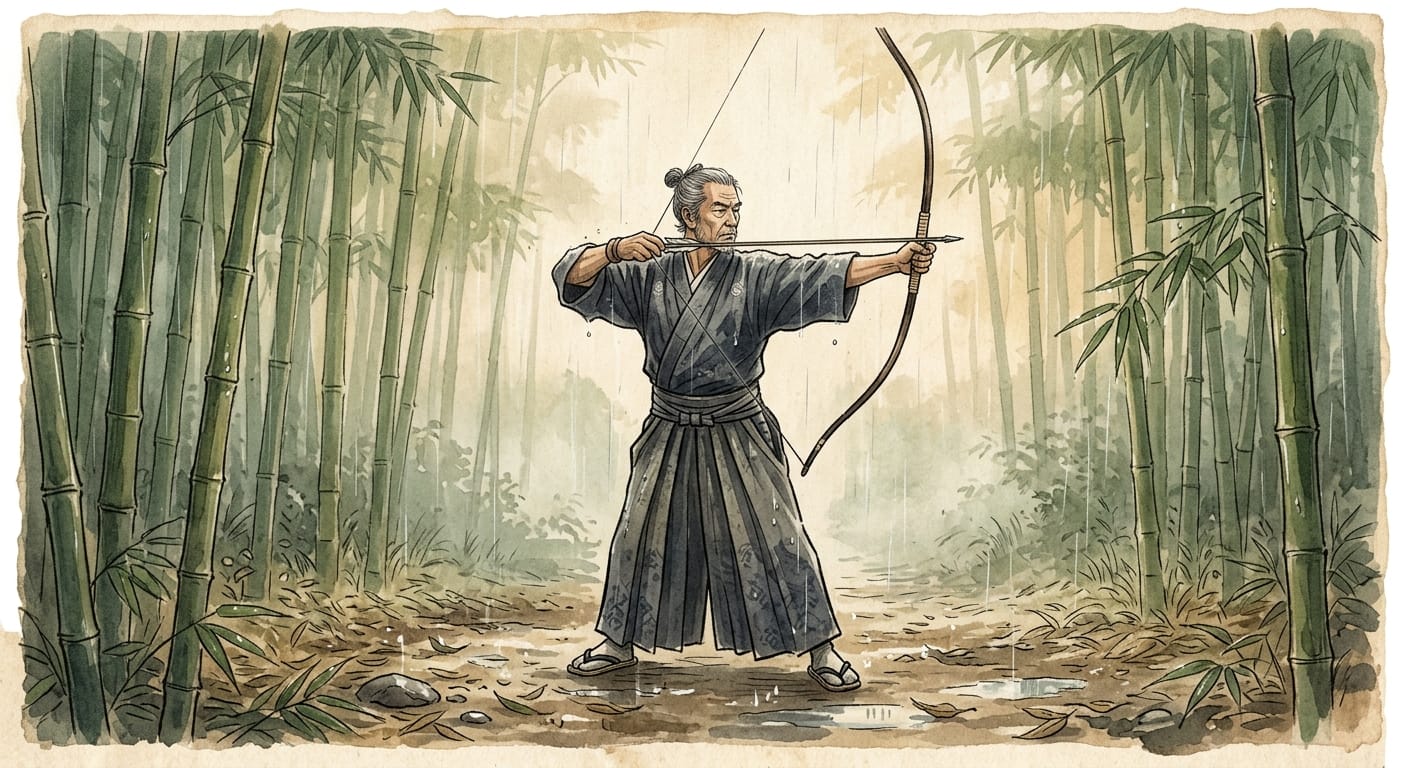
The Origin: A People Between Natural Forces
To understand Gambaru, one must look at the geography of Japan. A country that has been confronted with earthquakes, typhoons, and harsh winters for millennia. In such an environment, "giving up" is not an option. Gambaru arose from the necessity to get back up after every catastrophe, brush off the dust, and keep going, not with loud shouting, but with quiet, unagitated determination.
It is the virtue of the farmer who knows that rice needs time to grow and that hail can destroy the harvest, yet he sows again the following year. Gambaru is the acceptance that the way is the goal and that the effort itself has value, completely independent of the result.
Psychological Depth: From Must to Will
The decisive difference between "compulsion" and Gambaru lies in autonomy. When we force ourselves into something, we are fighting a part of ourselves. When we practice Gambaru, we say yes to our own choice. We accept that the way is difficult, but we consciously choose to carry this difficulty.
It is the realization that true self-confidence doesn't arise from everything succeeding, but from knowing: "I am someone who stays, even when it becomes uncomfortable."
Gambaru in Application: Your Gentle Strength
- Long-term Goals and the "Dry Spell": Every big change, whether it's learning a new language, building a business, or healing one’s own psyche, has a phase where the initial euphoria has vanished. It feels tough; you see no progress. This is where Gambaru saves you. It doesn't whisper: "You must achieve greatness today," but: "Just keep standing. Just take today's step, no matter how small it is." It is loyalty to your own process.
- Gambaru in Difficult Life Phases: There are times of grief, separation, or professional uncertainty where you feel weak. Gambaru doesn't demand heroic deeds in these moments. Rather, it means preserving dignity in everyday life. Making the bed, eating healthily, remaining kind to yourself while it storms outside. It is "persevering" in the storm until the sun breaks through again.
- Consistency in Partnership: Every long relationship has phases of emotional drought or routine. Gambaru in love means not running away at the first sign of boredom or difficulty. It is the decision to hold the space for the relationship, to remain present, and to engage with each other again and again. It is the gentle persistence that forges real, deep love out of infatuation.
- The Cultivation of Talents: One doesn't become a master of their craft through talent, but through Gambaru. It is the daily appearance at the workbench, at the desk, or at the instrument. It is the love of repetition. Gambaru transforms the burden of practice into a meditative form of dedication.
The Practice: Awakening the Spirit of Gambaru
Gambaru is like a muscle that you can train without injuring yourself.
- The Dignity of the Small Act: If you have a task ahead of you that takes effort, do it with full mindfulness. Not quickly-quickly, but with respect for the activity. That is Gambaru in small ways.
- Acceptance of Discomfort: When it gets difficult, tell yourself: "This is now the part called Gambaru." Acknowledge the discomfort without fleeing from it. Feel how you grow while you simply stay.
- The End of Excuses: Gambaru means being honest with yourself. If you truly have no strength one day, that is Wabi-Sabi (imperfection). But if you just don't feel like it, it's the moment for Gambaru. Learn to feel the difference.
Your Reflection: Where in your life have you recently thrown in the towel too early because it "didn't feel good anymore"? What would happen if, in precisely those moments, you didn't look for an exit but decided to go just a bit further? Not out of compulsion, but out of respect for your own desire for change.
The New Foundation: Your Path to a Personal Level-Up
We have now traveled five ancient paths rooted deep in the heart of Japanese wisdom. But while we have viewed them individually, their true magic lies in their synergy. They are not just isolated techniques, they are the building blocks of a completely new architecture of your self.
Perhaps you have often felt like a player stuck in a level you simply can't master. You thought you lacked talent, discipline, or luck. But the truth is: you were merely trying to navigate new terrain with an outdated map.
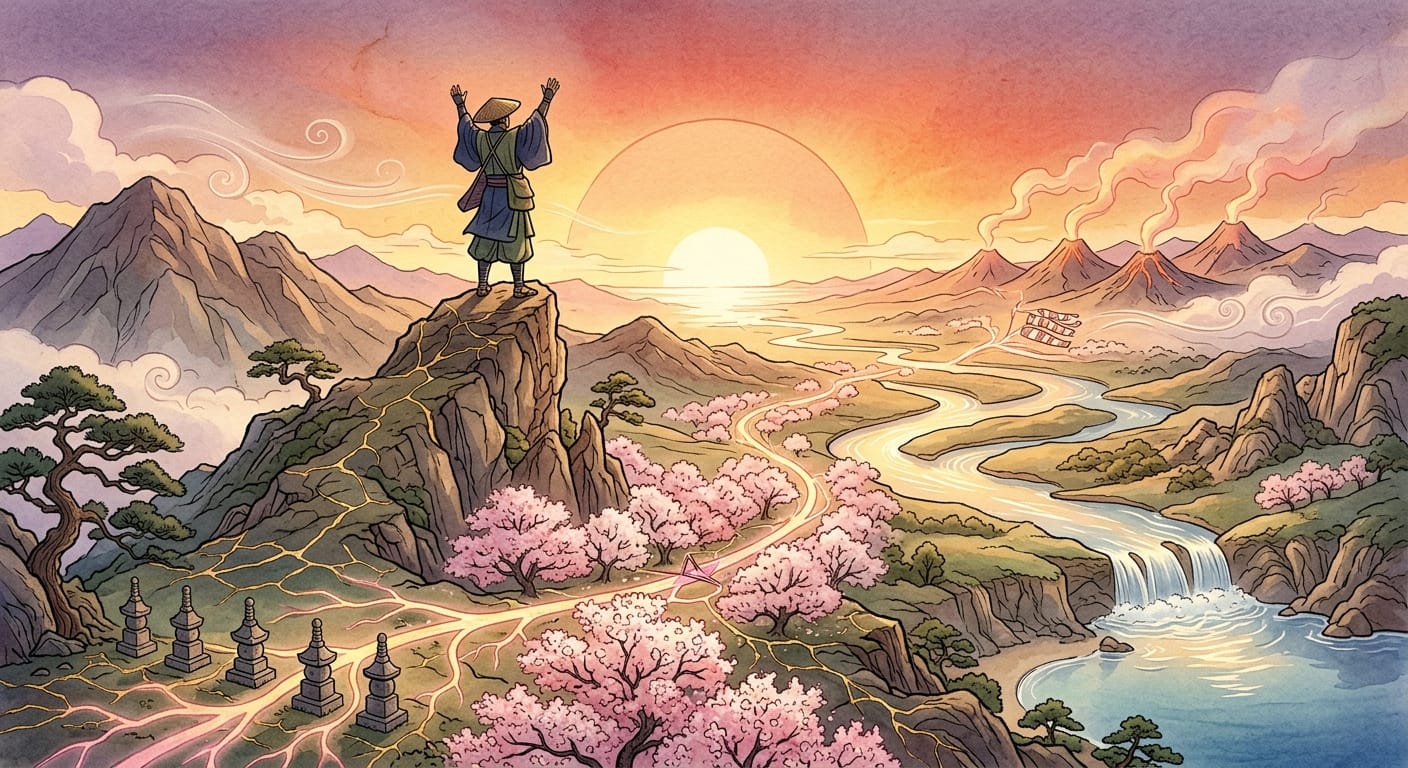
The Synergy of the Five Forces
When you weave these teachings together, an unstoppable dynamic arises:
- Kaizen takes away the burden of the impossible. It whispers to you that you don't have to move the whole mountain at once. A single small stone a day is enough to have created a new world after a year.
- Ikigai is the light that illuminates this path. It ensures you don't get lost in the thicket. You no longer search for meaning in the far distant somewhere, but feel it in every conscious breath and every small deed.
- Hara Hachi Bu gives you the necessary energy. By learning to pause in time, you preserve the strength for the entire journey. You no longer burn out; instead, you glow constantly.
- Wabi-Sabi frees you from the fear of failure. It takes the terror out of stumbling. The cracks in your life are not defects, but the places where you have grown strongest. They are your gold.
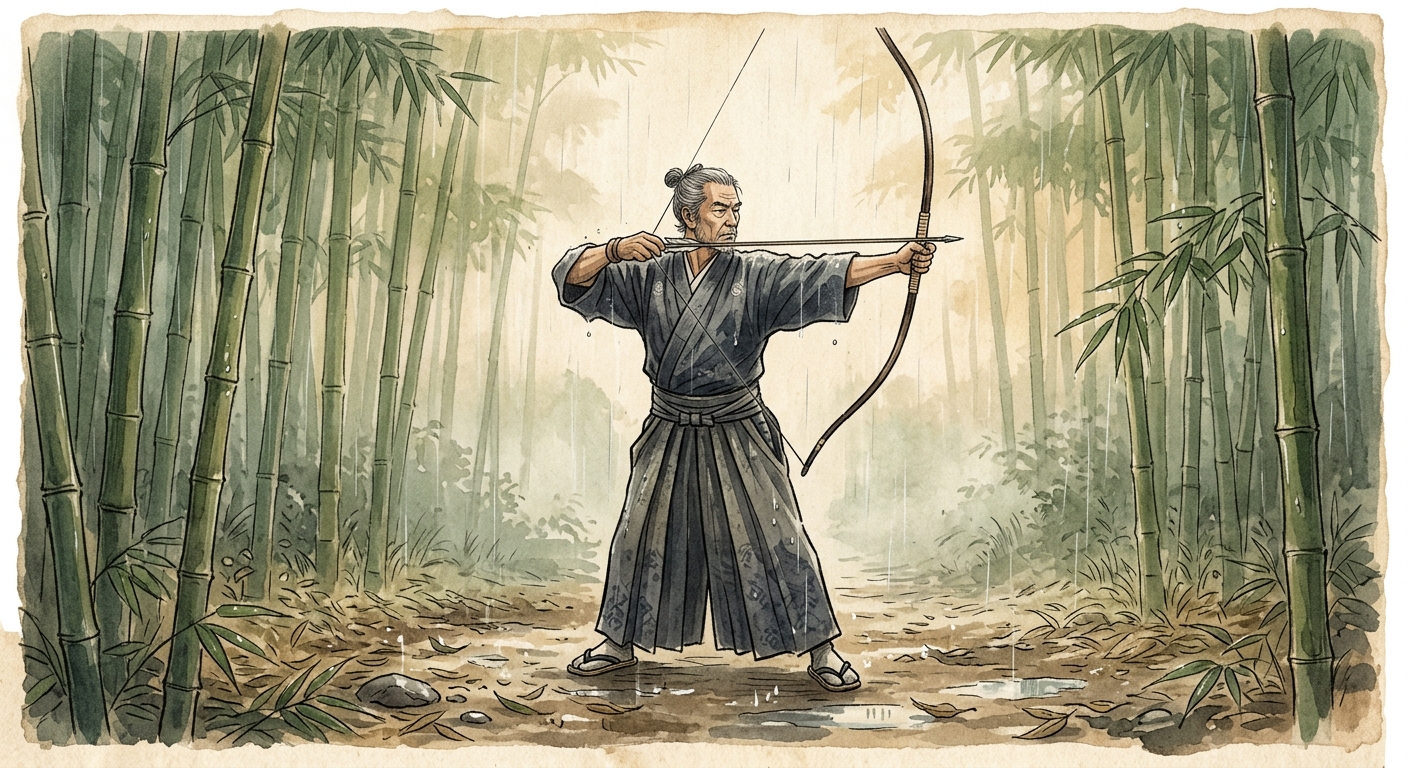
- Gambaru, finally, is your promise to yourself. It is the backbone of your transformation. It ensures that you don't stop when it rains, but that you learn to dance in the rain until the sun returns.
Your Identity is Not a Rigid Object
The most important realization of this journey is this: Your identity is not a destiny carved in stone. It is a fluid process. You are the architect and the author of your own life. You don't need extraordinary talent to lift your life to the next level. All you need is a new perspective on what is already there.
You deserve to be the version of yourself that you have long seen within you in the silence. The "new you" is not someone you have to create artificially. It is the you that emerges when you shed the pressure of perfection and choose daily, gentle dedication instead.
Your First Step into the New World
These five teachings are now part of your toolbox. You don't have to master them perfectly, remember Wabi-Sabi. It is enough if you begin to see the world through their eyes.
Change doesn't happen with a massive bang. It happens quietly, constantly, and with a deep love for detail. You have the full decision-making power. You have the tools. And you have the time you need.
Go now. Not with the goal of reaching the summit today, but with the joy of taking the first, tiny step today. Your level-up has already begun, the moment you decided to look closer.



![Gothic Remake: Chronicles of an Outcast [Arc 2/5]](https://storage.ghost.io/c/b7/cc/b7ccd268-3761-4206-93e3-835db1bfc937/content/images/size/w600/2026/07/Gemini_Generated_Image_ccdz1gccdz1gccdz.png)